
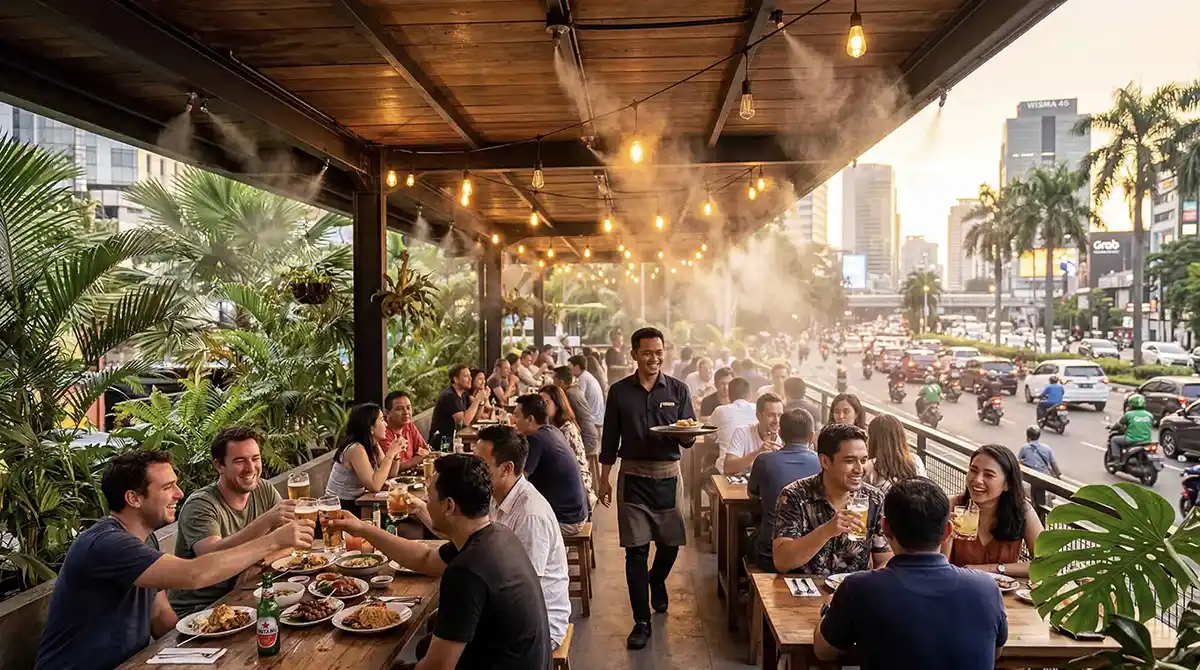
Indonesia’s toll-road rest areas are among the country’s busiest commercial formats: thousands of vehicles stop daily, passengers get out to eat and stretch — and nearly all of it happens on open asphalt during the hottest travel hours. Mudik season doubles everything.
For rest-area operators and the UMKM tenants inside them, heat is a revenue factor rarely counted: an overheated passenger buys bottled water and returns to the car — instead of sitting down for a meal.
The anatomy of rest-area heat
Asphalt and concrete in every direction. The vast parking aprons absorb sun all day and radiate it back — a midday rest area is a man-made heat island, degrees above the rice fields around it.
Semi-open dining zones. Food courts and UMKM tenant terraces are designed open for foot traffic — AC is irrelevant in this format, and rows of fans add noise to a place already full of it.
People arrive exactly at peak heat. Stop traffic follows travel hours — lunch and afternoon. Unlike a city cafe that can live off evening trade, a rest area sells comfort precisely when it’s hardest to provide.
Where mist works at a rest stop
- Food courts and outdoor dining zones — lines on the existing canopies; the food court logic applies in full, and tables stay dry for the nasi padang and the phones beside it.
- UMKM tenant row terraces — the kiosk row logic: one shared line along the visitor corridor beats fifteen tenant fans.
- Waiting zones and queues — restroom lines at mudik peak, minimarket checkout queues; queue zones are misting’s most efficient case.
- The rest-area musala — its forecourt and waiting areas, with the same dry-mat condition as a mosque.
A note for gas stations: mist is plain water — but the zones remain the seating, minimart and waiting areas, never the pump islands: the system’s pump sits in a technical room to electrical standards, well away from fueling areas.
Not sure what fits your space?
Send a photo of the area on WhatsApp — we’ll size the system and send a quote within a day. 600+ installations across Indonesia.
The operator’s arithmetic
A rest area lives on two numbers: how many vehicles stop, and how long people stay. Comfort doesn’t change the first — but it changes the second: a comfortably seated passenger orders food, not just water. For tenants, the difference between “takeaway” and “sit down and eat” is the revenue difference per car.
Costs follow the pattern of every installation of ours: thousands of rupiah a day in electricity, seating zones landing in the mid machine range, and maintenance run by your own staff — a natural fit for rest-area operations that already run daily cleaning teams.
The short version
A rest area sells a comfortable stop at the hottest point of the day, on an asphalt island radiating heat — and its dining zones, tenant rows and queues are classic misting cases: semi-open, busy, with tables that must stay dry. We’ve proven the scale at an airport; a rest area is the same case in toll-road format.
Operating a rest area, a highway food court, or a gas station’s commercial zone? Send a layout or photos, approximate areas, and the location via WhatsApp — we’ll survey and design zones around your visitor flow.
Ready to cool your venue?
Chat on WhatsApp