
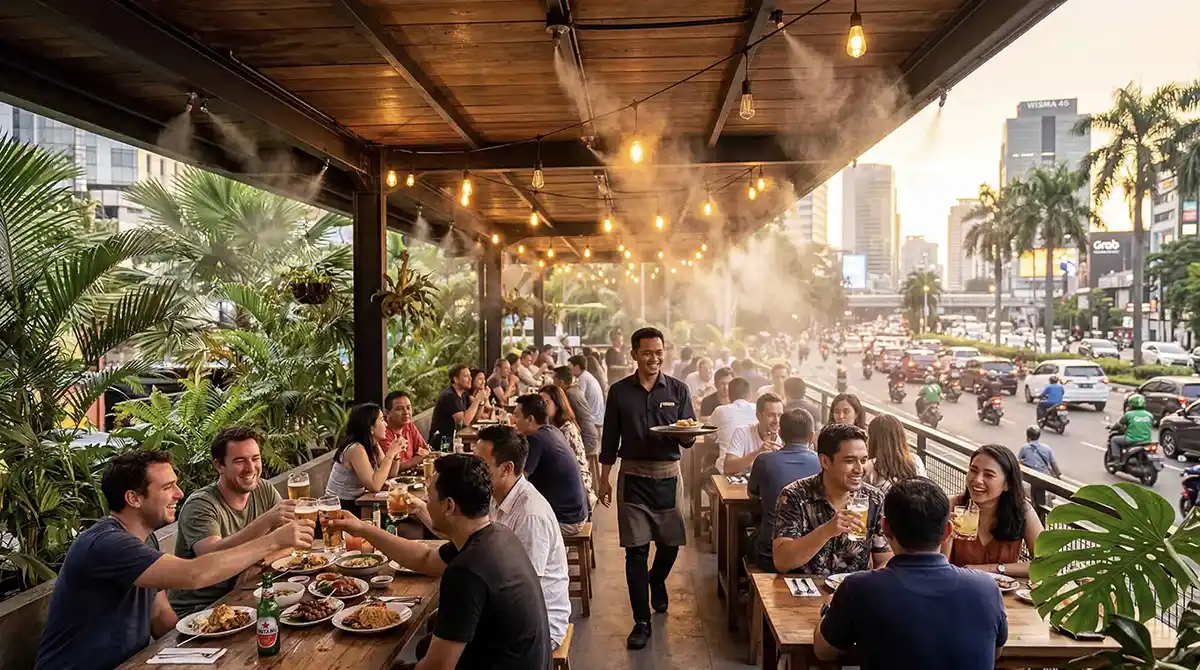
Indonesia’s food court culture is expanding outdoors. What started as air-conditioned mall food halls is evolving into open-air artisan food markets, outdoor food parks, and mixed-use dining destinations that combine multiple vendors under a shared outdoor structure. From the PIK district in North Jakarta to Bali’s beachfront dining complexes, the format is growing because it works — lower build-out costs than enclosed malls, higher perceived value for guests, and flexible tenant configurations.
But outdoor food courts face a problem that indoor ones do not: heat. A 300-500 square meter open-air dining area in Indonesia’s tropical climate, with cooking stations generating additional heat, becomes physically unpleasant by late morning. Guests eat faster, visit less often during peak afternoon hours, and choose air-conditioned alternatives when available. For food court operators, this translates directly to lower foot traffic, shorter visit duration, and unhappy tenants.
Solving this problem at food court scale requires a different approach than cooling a single restaurant terrace.
The Scale Challenge
A typical restaurant terrace might be 40-80 square meters. An outdoor food court common dining area ranges from 200 to 800 square meters or more, with additional vendor stall areas that also need cooling. The perimeter is often fully open — no walls to contain cooled air, no option to seal the space for air conditioning.
This rules out conventional AC entirely. You cannot air-condition an open-sided structure of this size at any reasonable cost. Industrial fans help with air movement but do not reduce actual temperature — they just move hot air faster. Shade structures reduce direct solar heat but do not address the 30-35 degree ambient temperature or the radiant heat from cooking equipment.
High-pressure mist cooling is the only active cooling technology that works effectively in fully open large-format spaces. Systems operating at 70 bar pressure create 10-micron water droplets that evaporate almost instantly in tropical air, absorbing heat energy in the process and dropping ambient temperature by 8-10 degrees Celsius. The mist does not wet surfaces, food, or guests — it disappears into the air as it cools.
Zoned Cooling for Multi-Tenant Layouts
Food courts are not uniform spaces. They have distinct zones with different cooling needs:
Common Dining Area
The largest zone and the primary space guests experience. Mist lines run along the overhead structure — pergola beams, tension cable arrays, or canopy edges — in a grid pattern that provides even coverage across the seating area. Nozzle spacing is calculated based on area dimensions, prevailing wind patterns, and the degree of shade provided by the roof structure.
For a 300 square meter common dining area, a combination of MistPro 300 units (each covering up to 300 sqm) provides comprehensive coverage. Larger areas of 500-800 square meters use multiple units with interconnected line networks.
Vendor Stall Zone
Cooking stations generate significant additional heat from grills, fryers, and woks. Mist cooling along the front edge of the vendor row — facing the dining area — creates a thermal barrier that prevents cooking heat from radiating into the guest zone. This also improves working conditions for vendor staff, who are standing next to heat sources for hours.
Transition and Walkway Areas
The paths between vendor stalls and dining areas benefit from overhead mist lines that create a consistently cool experience as guests move through the space. This prevents the jarring temperature shift between a cooled dining area and an uncooled walkway.
Not sure what fits your space?
Send a photo of the area on WhatsApp — we’ll size the system and send a quote within a day. 600+ installations across Indonesia.
Multi-Tenant Considerations
Food court operators face a unique challenge: the cooling infrastructure serves multiple independent businesses. This creates questions about cost allocation, maintenance responsibility, and system control.
Centralized system, shared cost. The most effective model is a single centralized mist cooling system owned and maintained by the food court operator, with the cost built into tenant common area maintenance (CAM) fees. This ensures consistent coverage, professional maintenance, and no gaps where one tenant opts out and creates a hot zone.
Operating cost is negligible at scale. A mist cooling system covering 300-500 square meters of dining area consumes Rp 2,000-8,000 per day in electricity and water. Split across 10-20 tenants through CAM fees, the per-tenant cost is essentially zero — far less than the individual AC units each tenant would otherwise need for their stall.
Maintenance is centralized. One system, one maintenance schedule, one responsible party. The 6mm stainless steel lines used in commercial-grade systems are designed for durability in high-use environments. Annual nozzle cleaning and pump servicing keep the system running at peak performance.
ROI for Food Court Operators
The business case for cooling a food court is not about comfort for its own sake. It is about measurable revenue impact across multiple dimensions:
Extended Operating Hours
An uncooled outdoor food court in Indonesia sees a steep drop in traffic between 11 a.m. and 4 p.m. — the hottest five hours of the day, which also overlap with lunch service, the highest-revenue meal period for most food court tenants. Mist cooling eliminates this dead zone, keeping the space comfortable for continuous operation from morning through evening.
If cooling recovers even 30% of the lost midday traffic, the revenue impact across all tenants is substantial. For a 20-tenant food court averaging Rp 3-5 million per tenant per day, a 30% lift during the 5-hour midday window represents Rp 9-15 million per day in additional revenue across the property.
Tenant Retention and Occupancy
Food court tenants pay attention to foot traffic. A venue where the common area empties during midday will struggle to retain quality tenants, leading to higher vacancy rates and lower CAM fee collection. A consistently comfortable, well-trafficked environment is the strongest tenant retention tool an operator has.
Higher Foot Traffic and Dwell Time
Cooled outdoor food courts report 20-30% higher overall foot traffic compared to uncooled equivalents in similar locations. Average visit duration increases by 15-25 minutes, during which guests typically order additional drinks or desserts. For food court tenants, longer dwell time directly increases per-visit spend.
Competitive Positioning
In Jakarta’s PIK area, Bali’s growing food park scene, and emerging outdoor dining clusters in Surabaya and Bandung, the food courts that invest in guest comfort attract better tenants, charge higher rents, and build stronger reputations. Cooling is a differentiator that signals operational quality to both tenants and guests.
System Sizing for Food Courts
| Food Court Size | Recommended System | Estimated Cost | Daily Operating Cost |
|---|---|---|---|
| Small (100-150 sqm dining) | 1x MistPro 200 | Rp 16.9M | Rp 2,000-3,000 |
| Medium (150-300 sqm dining) | 1x MistPro 300 | Rp 18.9M | Rp 3,000-5,000 |
| Large (300-600 sqm dining) | 2x MistPro 300 | Rp 37.8M | Rp 5,000-8,000 |
| Very Large (600+ sqm dining) | Custom multi-unit | Custom quote | Rp 8,000-15,000 |
All systems use 6mm stainless steel lines and come with a 1-year machine warranty. Installation typically takes 1-3 days depending on the size and complexity of the overhead structure.
Implementation Approach
For food court operators considering mist cooling, the process starts with a site assessment:
- Area measurement and zone mapping — dining area, vendor zone, walkways, and any VIP or event sections that need separate coverage
- Structure assessment — evaluating the existing roof or canopy structure for mist line mounting points
- Wind and shade analysis — prevailing wind direction affects nozzle placement and spacing
- Water source and power — confirming adequate water pressure and electrical capacity for the pump unit
MistSystem has completed installations for food courts, hotel dining areas, beach clubs, and large commercial venues across Bali, Jakarta, and Surabaya. With 600+ total installations since 2024, the team has specific experience with multi-zone commercial layouts.
The same approach scales up: see our open-air mall installation at BeachWalk Kuta.
Get a site assessment and custom quote for your food court: +62 851 9029 1717
Ready to cool your venue?
Chat on WhatsApp