
Motorbike and car workshops are among the hottest workplaces in Indonesia — and among the last anyone thinks of cooling. The tin roof soaks up the sun, every vehicle that rolls in is still hot from the road, welding gear and compressors add heat from inside, and in the middle of it all a mechanic works bent over for eight hours a day.
For the owner this isn’t just empathy: an overheated mechanic works slower, breaks more often, and makes more mistakes — in a trade where mistakes are expensive.
The anatomy of workshop heat
The equation resembles a warehouse, with two extra weights:
- Internal heat sources arrive all day. Every vehicle on the lift brings an engine and exhaust still glowing from the road — the workshop gets its heat “topped up” every hour.
- The doors never close — that’s the workflow; AC is irrelevant from the start, and fans merely deliver hot air to the skin faster.
Add the physical workload — the same logic as a gym: a hard-working body is an extra heater in an already hot room.
Which workshop zones deserve mist — and which don’t
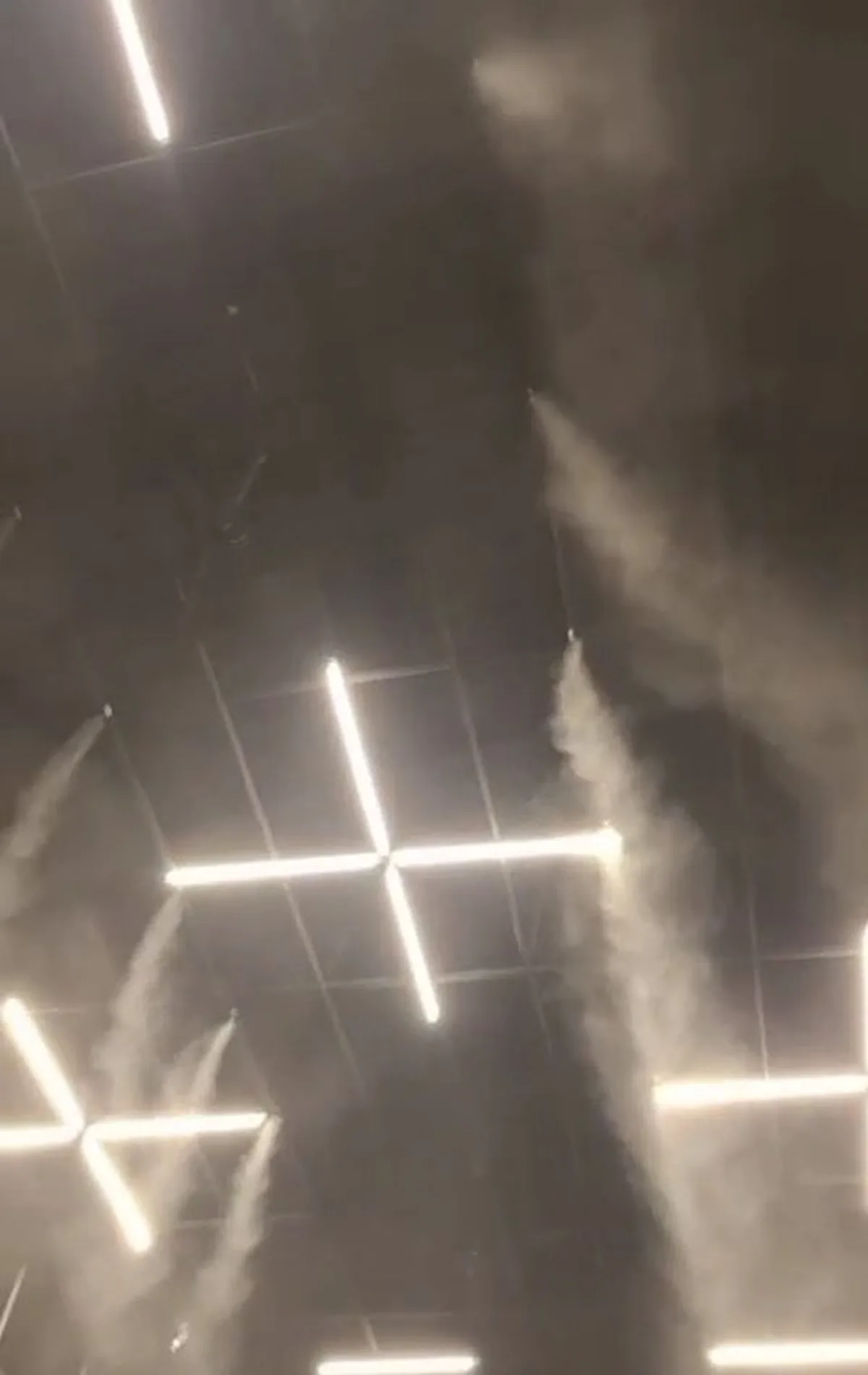
The main work bays. Lines on the roof frame above the working zones — sub-10-micron droplets evaporate in the air, so tools, vehicle electronics and the floor stay dry. In a workshop that’s no small detail: an oily floor plus water is a combination that must never exist — which is exactly why coarse sprayers are dangerous in a workshop, while fine mist never touches the floor at all.
Welding and paint zones — deliberately not. Welding wants stable conditions for joint quality, and a paint area needs its own atmosphere control — mist there is no help. Honest zoning: cool where people work, skip the process zones.
The customer waiting area. Customers waiting out a service on plastic chairs by the roadside are the classic waiting-zone case — and often the cheapest zone to add from the same machine. A comfortable customer approves the extra work item; an overheated one says “maybe later”.
Not sure what fits your space?
Send a photo of the area on WhatsApp — we’ll size the system and send a quote within a day. 600+ installations across Indonesia.
The workshop owner’s arithmetic
A workshop sells mechanic hours — and the midday hours that “melt” are silently lost capacity: breaks stretch, precision work drifts to mornings, the service queue slips. A mid-size workshop’s work zones land in the small-to-mid machine range, running costs sit at thousands of rupiah a day, and the maintenance folds into the open-close routine you already run — workshops live on checklists anyway.
One serious requirement: water quality. Many workshops run on well water — filtration here isn’t an option, it’s a must.
The short version
A workshop is a tin box that takes on a fresh heat source every hour, with people doing physical work inside it all day. Mist cools the work bays and the waiting area while keeping tools, electronics and the oily floor dry — and deliberately skips the welding and paint zones.
Running a workshop that turns into an oven by noon? Send photos of the work bays and waiting area, approximate sizes, and your city via WhatsApp — we survey within 48 hours and design zones that route around your welding area.
Ready to cool your venue?
Chat on WhatsApp