
Every mosque administrator knows the Friday arithmetic: the main hall fills, the rows continue onto the forecourt, and the congregation in the courtyard prays under the midday sun. On holidays the ratio flips — the courtyard becomes the main space. And unlike a cafe that can close its terrace in the heat, a mosque doesn’t choose its operating hours: prayer time is prayer time.
Here’s how mist cooling works for mosque courtyards — with one non-negotiable condition that happens to be exactly why the technology fits: everything must stay dry.
Why a mosque courtyard is a special cooling case
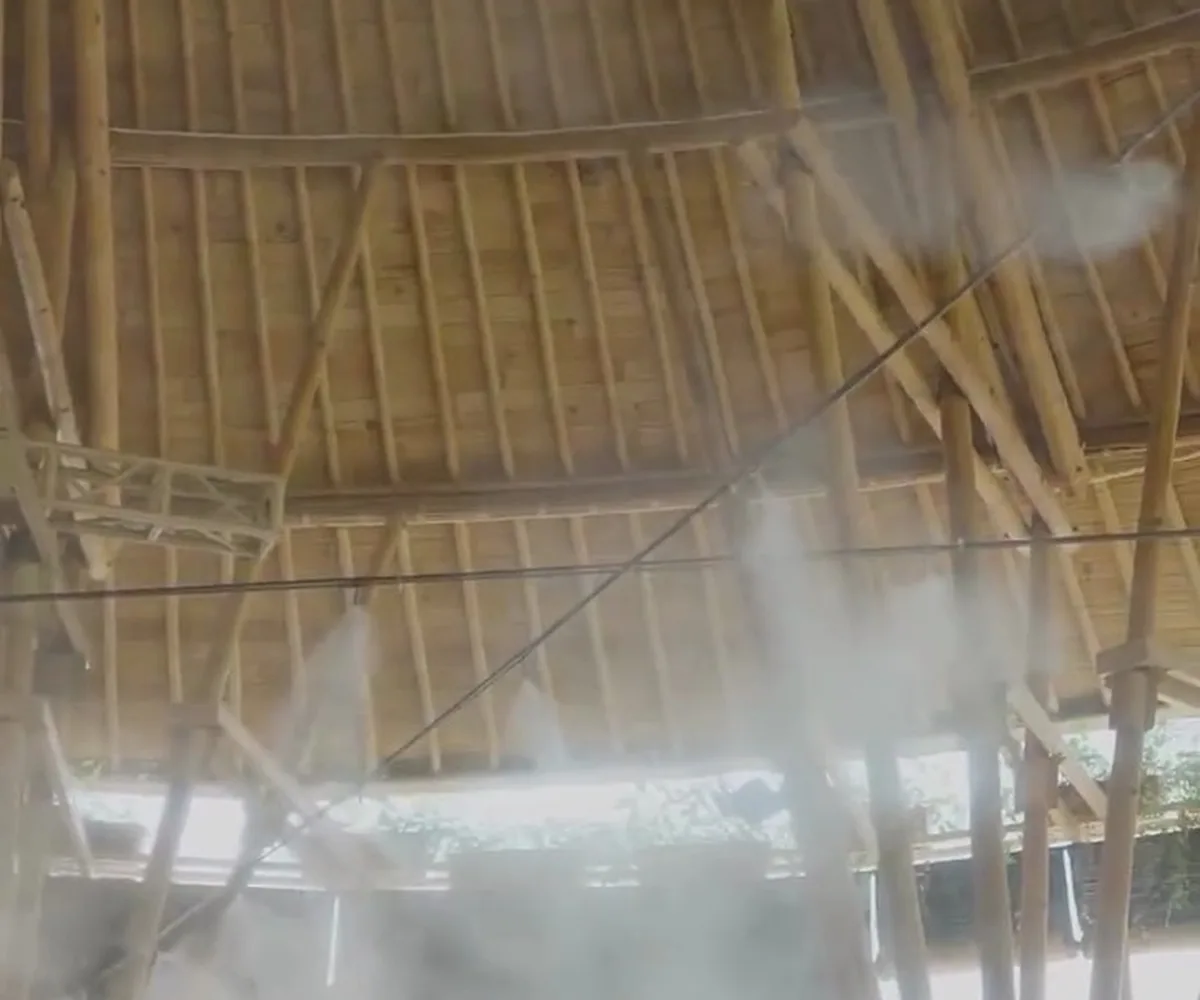
Prayer mats cannot get wet. This is the red line that disqualifies ordinary sprayers and heavy-droplet mist fans from any forecourt: 50+ micron droplets land on mats and on the congregation’s clothing. Sub-10-micron droplets evaporate in the air — the mist cools the outer rows without touching anything beneath it.
The peaks are short and dense. A mosque’s load isn’t eight flat hours — it’s 30–60 very dense minutes several times a day, with the absolute peak at Friday noon. A zoned system switches on before the call to prayer and off after the congregation disperses; the electricity cost follows those short operating windows.
Silence is a requirement. The sermon and the prayer cannot compete with fan blades. On an installed system the pump sits in a technical room; the forecourt carries only silent stainless lines — the fundamental difference from rows of fans.
The zones where it counts most
- The forecourt and outer prayer rows — a line along the roof edge or forecourt canopy, running before prayer begins.
- Waiting areas and walkways — early arrivals wait comfortably instead of hunting for a shaded wall.
- Courtyards for iftar gatherings and study circles — during Ramadan the forecourt becomes an event space; the event-cooling logic applies in full.
- The ablution area — deliberately not. Wudu areas are wet by function; mist adds nothing there. Honest zoning matters more than more zoning.
Not sure what fits your space?
Send a photo of the area on WhatsApp — we’ll size the system and send a quote within a day. 600+ installations across Indonesia.
Ramadan: when the courtyard works hardest
Tarawih moves the crowded hours into the evening — cooler, but iftar gatherings and afternoon study still fall in the heat, and i’tikaf keeps the complex alive longer than usual. A zoned system follows this calendar without reconfiguration: forecourt zones for Fridays, courtyard zones for iftar, all from one machine.
Congregations from hundreds to thousands aren’t an obstacle — the principle is the same as at any large venue: cool the zones where people are, not the whole air volume.
For mosque committees
The conversation usually starts from two numbers: the forecourt area used by the outer rows, and the Friday congregation size. From there we design the zones, and the installation process is the same as anywhere: a 48-hour survey, a 1–3 day installation — scheduled around prayer times, without disrupting the mosque’s activities. The full approach for mosques is on the mosque solutions page.
The short version
A mosque courtyard is the cooling case with the strictest conditions — absolutely dry, silent, and built for short dense peaks — and precisely those conditions make high-pressure mist the right answer: evaporating before it reaches a prayer mat, soundless on the forecourt, zoned around the prayer schedule.
Send photos of the forecourt, its approximate area, and your city via WhatsApp — we survey within 48 hours and design the zones around your rows, canopies, and the mosque’s calendar.
Ready to cool your venue?
Chat on WhatsApp