
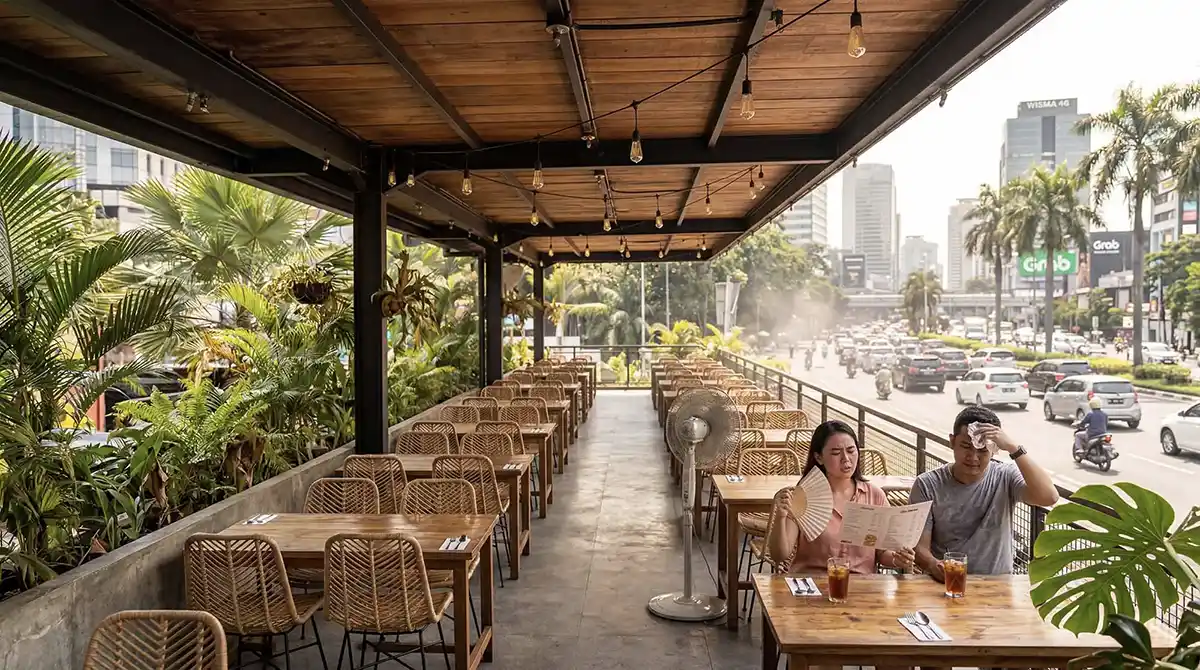
Every restaurant owner with a hot terrace has thought about it at least once: “Can we just put AC outside?” It seems logical. Air conditioning cools indoor dining rooms perfectly, so why not point a few units at the patio?
The short answer is no. Not because the equipment is bad, but because the physics do not allow it. Here is why air conditioning fundamentally cannot work in open-air spaces, what happens when you try anyway, and what actually solves the problem.
How Air Conditioning Works (and Why It Needs Walls)
To understand why outdoor AC fails, you need to understand how air conditioning actually works. It is not complicated, but the details matter.
An air conditioning unit does not create cold air. It moves heat. The system contains a refrigerant that cycles between an evaporator coil (inside) and a condenser coil (outside). Warm indoor air passes over the evaporator, which absorbs the heat. The refrigerant carries that heat to the condenser, which dumps it outside. The result: the indoor space gets cooler, and the outdoor space gets slightly warmer.
This process relies on one critical assumption: the indoor space is enclosed. Walls, ceiling, and windows create a sealed volume of air. The AC unit only needs to cool that fixed volume and then maintain it against gradual heat gain through insulation. Once the room reaches the target temperature, the compressor cycles down and energy consumption drops.
Now remove the walls. In an open-air space, the “inside” and “outside” are the same place. The AC unit pushes out cooled air, which immediately mixes with the unlimited volume of hot ambient air surrounding it. The cooled air, being denser than warm air, initially settles low, but wind, convection currents, and simple diffusion disperse it within seconds.
The compressor never cycles down. It runs at maximum capacity continuously because the target temperature is never reached. The unit is trying to cool an infinite volume of air. Thermodynamically, this is the equivalent of trying to empty the ocean with a bucket.
The Heat Dump Problem
There is a second physics problem that makes outdoor AC even less effective. Remember that the condenser coil dumps heat outside. When the unit is installed outdoors, the condenser dumps heat into the same space you are trying to cool. The unit is simultaneously cooling and heating the same open area. In a properly installed indoor system, the condenser sits outside and the heat goes away. Outdoors, it has nowhere to go.
This creates a feedback loop: the condenser warms the surrounding air, which then gets pulled back into the unit as intake air, which makes the evaporator work harder, which generates more waste heat at the condenser.
The Real Cost of Trying AC Outdoors
Physics aside, let us look at what actually happens when restaurants install outdoor AC. This is based on real-world observations from venues across Indonesia.
Energy Consumption
An indoor AC unit rated at 2.5 kW cools a 25 m2 room effectively. That same unit placed outdoors cools effectively nothing, because the cooled air dissipates before it reaches guests two meters away.
To get any perceptible cooling effect on a 100 m2 terrace, you need 3-5 large commercial units running simultaneously. Each draws 3-5 kW. Running 8-12 hours per day, that is 72-300 kWh daily. At commercial electricity rates in Indonesia, the monthly bill for outdoor AC alone reaches Rp 1,500,000 - 6,000,000.
For context, an indoor restaurant of the same size would use roughly one-third to one-fifth that energy for the same (or better) cooling result.
Equipment Degradation
AC units installed outdoors face accelerated wear. In Indonesia’s tropical climate, you get:
- Salt air corrosion in coastal areas like Bali, accelerating condenser coil deterioration
- Dust and debris clogging filters faster than in indoor installations
- Rain exposure causing electrical component issues, even with weatherproof housings
- Constant maximum-load operation shortening compressor lifespan from 8-10 years to 3-5 years
The maintenance costs compound. More frequent filter replacements, refrigerant top-ups (indicating leaks from corroded coils), and earlier full unit replacements.
Noise
A single indoor split-unit AC is quiet. Multiple commercial-grade outdoor units running at full compressor load are not. The combined noise of 3-5 outdoor AC units creates a constant drone that interferes with conversation, ambiance, and the overall dining experience. For venues that market their outdoor space as a relaxing environment, this is a direct contradiction.
Actual Cooling Performance
The most important metric: does it work? At best, outdoor AC creates a narrow zone of slightly cooler air extending 1-2 meters in front of each unit. Guests seated within this zone might feel a 2-3 degree Celsius difference. Guests three meters away feel nothing.
Wind eliminates even this modest effect. A light breeze of 10-15 km/h carries the cooled air away faster than the unit can produce it. In Bali and coastal Indonesia, where sea breezes are constant, outdoor AC becomes completely ineffective much of the time.
Not sure what fits your space?
Send a photo of the area on WhatsApp — we’ll size the system and send a quote within a day. 600+ installations across Indonesia.
What About Portable AC and Standing AC Units?
Portable and standing AC units (known as “AC standing” or “AC portable” in Indonesia) are a popular consideration for semi-outdoor spaces. These are self-contained units on wheels that can be positioned wherever needed.
The physics problem is identical, just at a smaller scale. A portable AC unit still works by refrigerant cycling. It still needs to dump heat somewhere. Most portable units exhaust hot air through a flexible duct. Indoors, that duct goes out a window. Outdoors, the hot exhaust goes right back into the space you are trying to cool.
Portable AC units are designed for temporary use in semi-enclosed spaces: a warehouse with an open bay door, a tent with partial walls, a room with a broken fixed AC. They are not designed for fully open terraces.
Additionally, a single portable unit produces 2-3 kW of cooling. Covering a restaurant terrace would require multiple units, each trailing a power cable and exhaust duct. The result is an expensive, noisy, cluttered arrangement that still does not meaningfully cool the space.
What Actually Works for Outdoor Cooling
The reason AC fails outdoors is that it tries to fight the open environment. It cools a pocket of air and then loses it to the atmosphere. The solution is a technology that works with the open environment instead of against it.
High-Pressure Mist Cooling
High-pressure mist cooling takes a fundamentally different approach. Instead of cooling a volume of trapped air, it changes the actual temperature of the ambient air in the target zone.
The system works through evaporative cooling, the same principle that makes you feel cool when you step out of a swimming pool. Here is the process:
- A high-pressure pump pressurizes water to 70+ bar (1,000+ PSI)
- The water is forced through precision nozzles with orifices as small as 0.1 mm
- This creates a fog of micro-droplets approximately 10 microns in diameter
- These droplets are so small that they evaporate almost instantly on contact with warm air
- The evaporation process absorbs heat energy from the surrounding air (latent heat of vaporization)
- The air temperature in the misted zone drops by 8-15 degrees Celsius
The critical detail: because the droplets evaporate before reaching surfaces, tables, chairs, and guests stay completely dry. This only works at high pressure (70 bar and above). Low-pressure systems produce larger droplets that do not fully evaporate and leave everything wet.
Unlike AC, this process does not require enclosed space. It actually works better with some airflow, because moving air brings more heat energy into contact with the evaporating droplets, expanding the cooling zone.
Comparison: Outdoor AC vs High-Pressure Mist Cooling
| Factor | Outdoor AC | High-Pressure Mist Cooling |
|---|---|---|
| Temperature reduction (open air) | 1-3 degrees C (near unit only) | 8-15 degrees C (entire zone) |
| Cooling coverage area | 1-2 m radius per unit | Full terrace, uniform |
| Daily energy cost (100 m2 terrace) | Rp 50,000 - 200,000 | Rp 2,000 - 5,000 |
| Monthly energy cost | Rp 1,500,000 - 6,000,000 | Rp 60,000 - 150,000 |
| Equipment noise | High (multiple compressors) | Silent (pump is remote-mounted) |
| Tables and guests | Dry | Dry (at 70+ bar pressure) |
| Works with wind | No (wind disperses cooled air) | Yes (airflow aids evaporation) |
| Maintenance frequency | High (filters, refrigerant, coils) | Low (nozzle cleaning, filter changes) |
| Equipment lifespan | 3-5 years (outdoor use) | 8-10 years (stainless steel lines) |
| Visual impact | Large, bulky units | Discreet 6mm stainless lines |
| Requires enclosed space | Yes (designed for it) | No (designed for open air) |
When AC Is the Right Choice
This article is not here to say air conditioning is bad technology. It is excellent technology — in the right application. AC is the correct choice for:
- Indoor dining rooms where walls and ceiling contain the cooled air
- Enclosed kitchen areas where climate control protects both staff and food storage
- Private VIP rooms with four walls and a door that closes
- Wine storage and cellar areas that require precise temperature control
- Hotel lobby areas that are fully enclosed
In any space where you can close the doors and windows, AC will outperform every other cooling method. The refrigerant cycle is efficient and precise when it operates within its design parameters.
The mistake is not using AC. The mistake is using AC where it cannot physically work — open-air spaces where the cooled air has nowhere to stay.
Choosing the Right Solution for Each Space
Most restaurants and hospitality venues have both indoor and outdoor spaces. The smart approach is to use each technology where it performs best:
- Indoor areas: air conditioning (split or central systems)
- Open terraces, rooftops, pool areas, garden dining: high-pressure mist cooling
- Semi-enclosed spaces (partial walls, retractable roof): either can work, depending on how much of the space is enclosed
For open-air terraces, rooftops, pool areas, and garden dining, mist cooling is the engineered solution. MistSystem has installed 600+ systems across Indonesia for exactly this reason. Each installation is designed around the specific venue layout, local climate conditions, and coverage requirements.
If you are currently running outdoor AC or considering installing it, a site assessment can show you exactly what temperature reduction is achievable with the right technology. Contact MistSystem on WhatsApp at +62 851 9029 1717 for a consultation.
Ready to cool your venue?
Chat on WhatsApp