
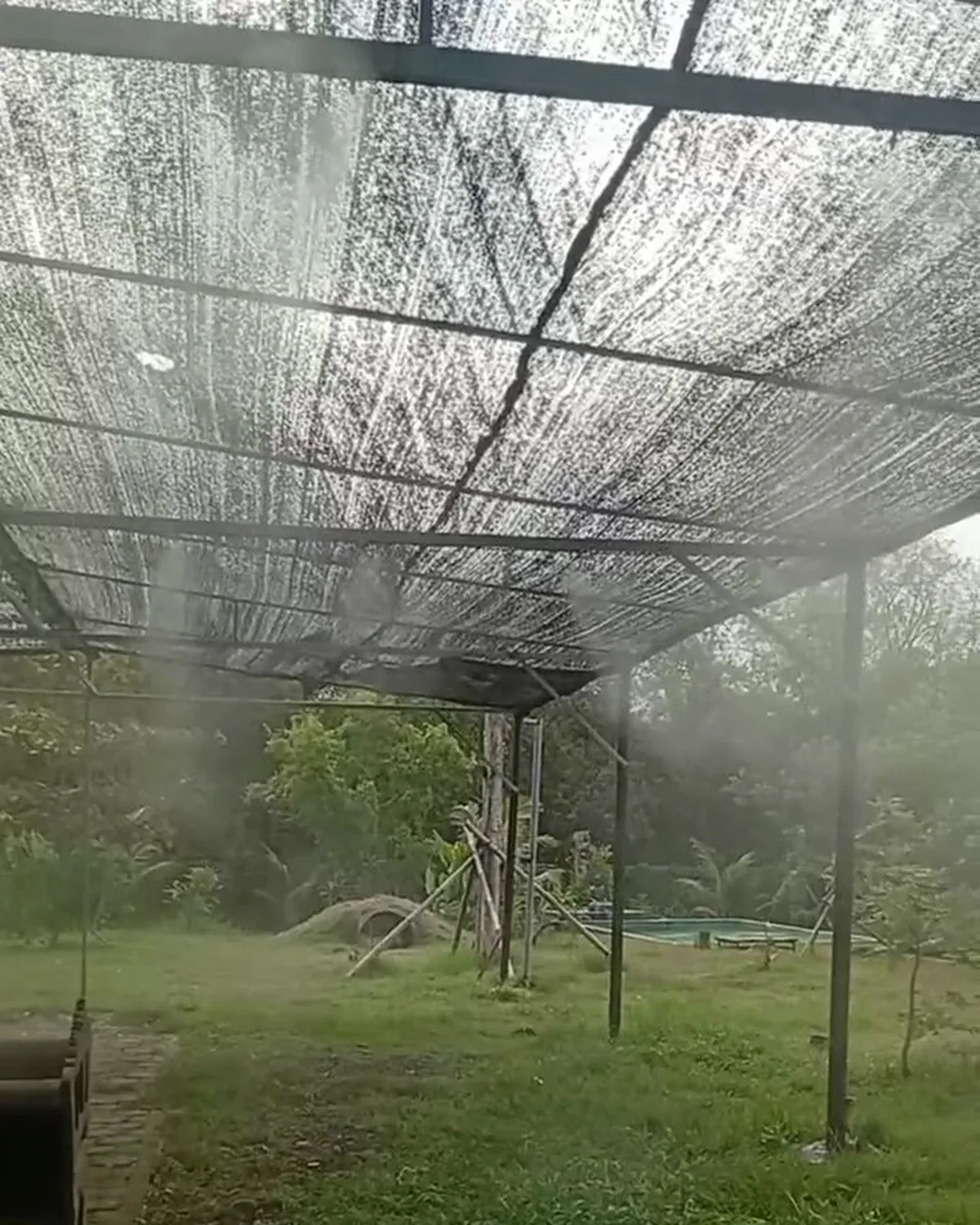
American zoos have used mist for decades: installations at major parks there cool primate enclosures, bird pavilions, even bat exhibits. The logic applies exactly to Indonesia’s animal parks — with one difference: in our climate the heat isn’t seasonal, it’s the daily default.
An animal park is a unique case because it combines three cooling problems that usually live separately — and we’ve already solved each of them elsewhere.
Three populations, three problems
The animals: residents who can’t leave. The same principle as a dog boarding facility and a dairy barn: an animal in an enclosure lives at whatever temperature the operator provides, and many species handle heat worse than humans — primates hunt for shade, birds pant open-beaked, large mammals simply stop moving. For a park this is also an experience problem: an exhibit whose animals are hiding from the heat is an empty exhibit in the visitor’s eyes.
The visitors: hours of walking on open paths. Families with small children — the group heat overwhelms fastest — cover kilometres of outdoor trails. A park that runs too hot shortens visits, and shorter visits mean lost food-court and souvenir spend.
The queues: gates, attractions, feeding times. Queue zones are misting’s most efficient case — narrow, fixed, dense — and we’ve proven visitor-flow scale at Bali’s airport.
Where mist works in an animal park
- Enclosure shade areas — lines on existing shade frames, as at the boarding facility we worked on: mist evaporates in the air, bedding and feed stay dry.
- Visitor paths and gathering points — mist zones on main-path canopies as “recharge stations” between exhibits.
- Gate and attraction queues — lines above the queue corridors.
- Food courts and show amphitheatres — the food court logic plus the animal-show seating bowls.
Zoning honesty: every species has different needs — some animals require absolute dryness, some exhibits deliberately run humidity high. That’s why an animal-park design always starts with the curators and vets, zone by zone, with separate controls — never one setting for the whole park.
Not sure what fits your space?
Send a photo of the area on WhatsApp — we’ll size the system and send a quote within a day. 600+ installations across Indonesia.
The operator’s arithmetic
An animal park sells visit duration: the ticket is paid once, but food courts, souvenirs and repeat visits follow how long and how comfortably a family lasts. The “dead” 11-to-3 stretch at an overheated park is the same lost inventory as at any venue — except here it’s multiplied by thousands of weekend visitors.
Running costs follow the pattern of every installation of ours — thousands of rupiah a day per zone — and a multi-zone system lets you start with the hottest areas first: the gate queues and main paths, then extend budget season by budget season.
The short version
An animal park combines three cases we’ve already built elsewhere: animals that can’t leave (Greenfields, the boarding kennel), large-scale visitor flow (Bali’s airport), and queues in the blazing sun. Mist serves all three from one platform — zone by zone, with your curators setting the design rules.
Managing an animal park, bird park, or recreation park with a live collection? Send the path layout and zones via WhatsApp — we’ll survey alongside your curator team and design zones starting from the hottest areas first.
Ready to cool your venue?
Chat on WhatsApp