
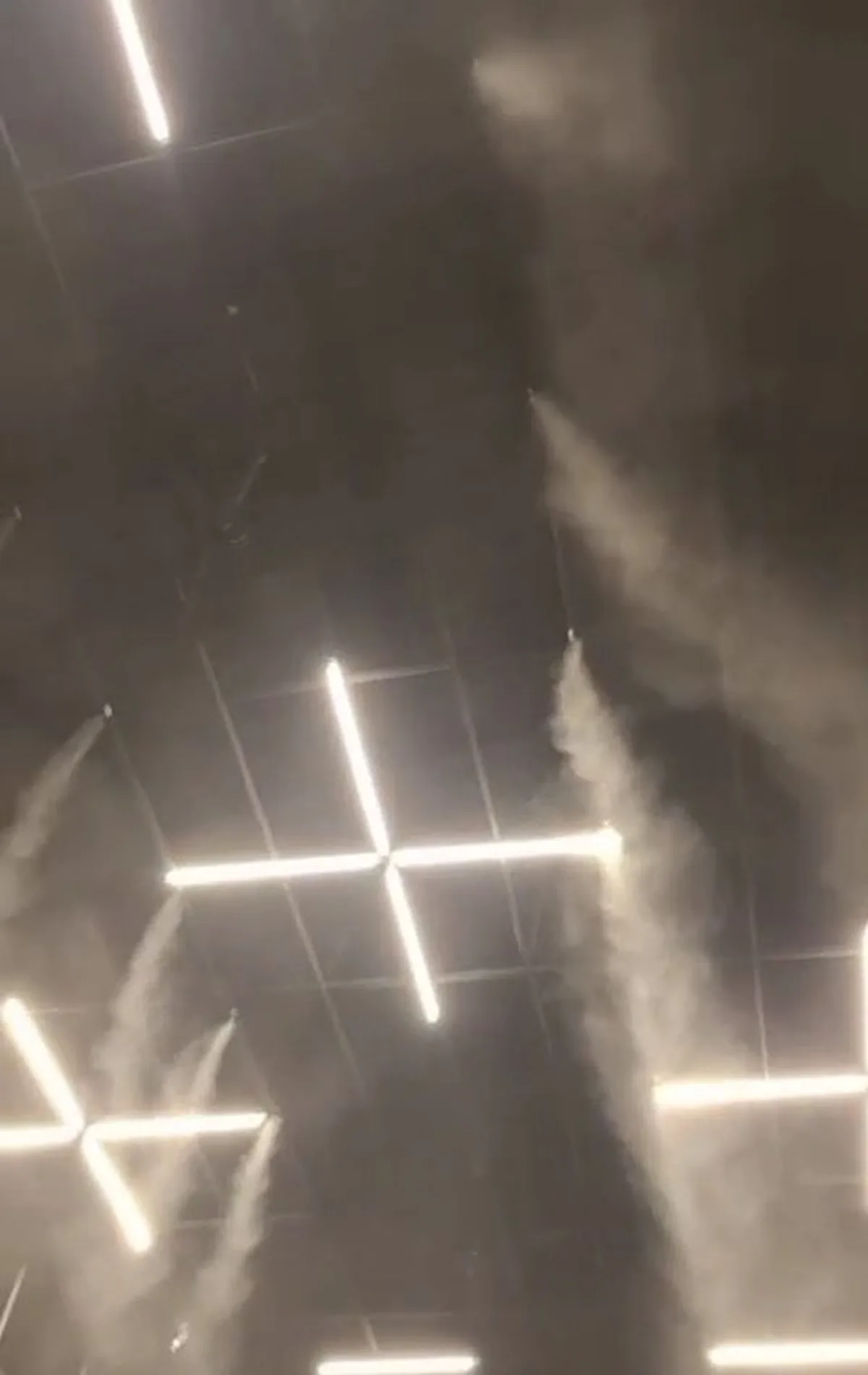
The semi-open gym is one of Bali’s — and urban Indonesia’s — most distinctive formats: muay thai camps roofed but wall-less, CrossFit boxes with roller doors permanently up, yoga studios facing a garden. The format is right for ventilation — and brutal for thermoregulation, because the occupants aren’t guests sitting with an iced coffee but people deliberately driving their heart rates up.
Why a gym runs hotter than the thermometer says
A hard-training body is a walking space heater: most of the energy muscles burn leaves as heat. Fill one class with twelve people doing intervals — and a semi-open space carries an internal heat load no restaurant terrace ever sees, on top of air that’s already 32°C.
Every camp owner knows the consequences: empty midday classes, schedules crammed into dawn and evening, and midday members training at half intensity. The 11:00–15:00 slots are dead inventory — exactly like padel courts, which we already cool in Banjarmasin alongside a golf court in Balikpapan.
The training-zone constraint: dry floors are not a preference
In a restaurant, a damp floor is a complaint. In a gym, it’s an injury: a muay thai stance, a lifting drive, a yoga pose — all stand on foot grip. Coarse sprayers and heavy-droplet mist fans are disqualified here harder than anywhere — and that’s exactly why sub-10-micron droplets evaporating mid-air are the only way to add evaporative cooling over a training zone without touching mats or floor.
The bonus athletes feel immediately: fine mist speeds the evaporation of sweat — the body’s own cooling mechanism works more efficiently rather than being replaced.
Not sure what fits your space?
Send a photo of the area on WhatsApp — we’ll size the system and send a quote within a day. 600+ installations across Indonesia.
Zone design for training formats
- The main class/mat zone — lines on the roof frame, mounting height following the evaporation calculation, never hung low “to be closer”.
- Between-rounds rest areas — in fight camps, the rest corner is where heart rates recover; a mist zone there works hardest per metre.
- The ring and sparring corners — perimeter lines, never directly over the ring: canvas stays absolutely dry.
- Waiting and spectator areas — parents waiting through kids’ classes, the same logic as queue zones.
Noise is no small detail either: an instructor calls cues all class long. A row of fans competes with that voice; a mist line is silent — the pump lives in a technical room.
The camp owner’s arithmetic
Revived midday slots mean extra classes without extra floor space — and for membership gyms, comfort is retention: members who train comfortably come more often and stay longer. Running costs sit at thousands of rupiah per day, and a training zone usually lands in the small-to-mid machine range.
The short version
Semi-open gyms combine the highest internal heat load with the strictest dry-floor requirement — a combination that sits precisely in high-pressure mist’s strengths: evaporating mid-air, dropping the zone by up to 10°C in the blazing hours, silent under the instructor’s cues.
Running a camp, box, or semi-open studio? Send photos of the training zones, sizes, and your city via WhatsApp — we survey within 48 hours and design lines around your roof frame and class schedule.
Ready to cool your venue?
Chat on WhatsApp