
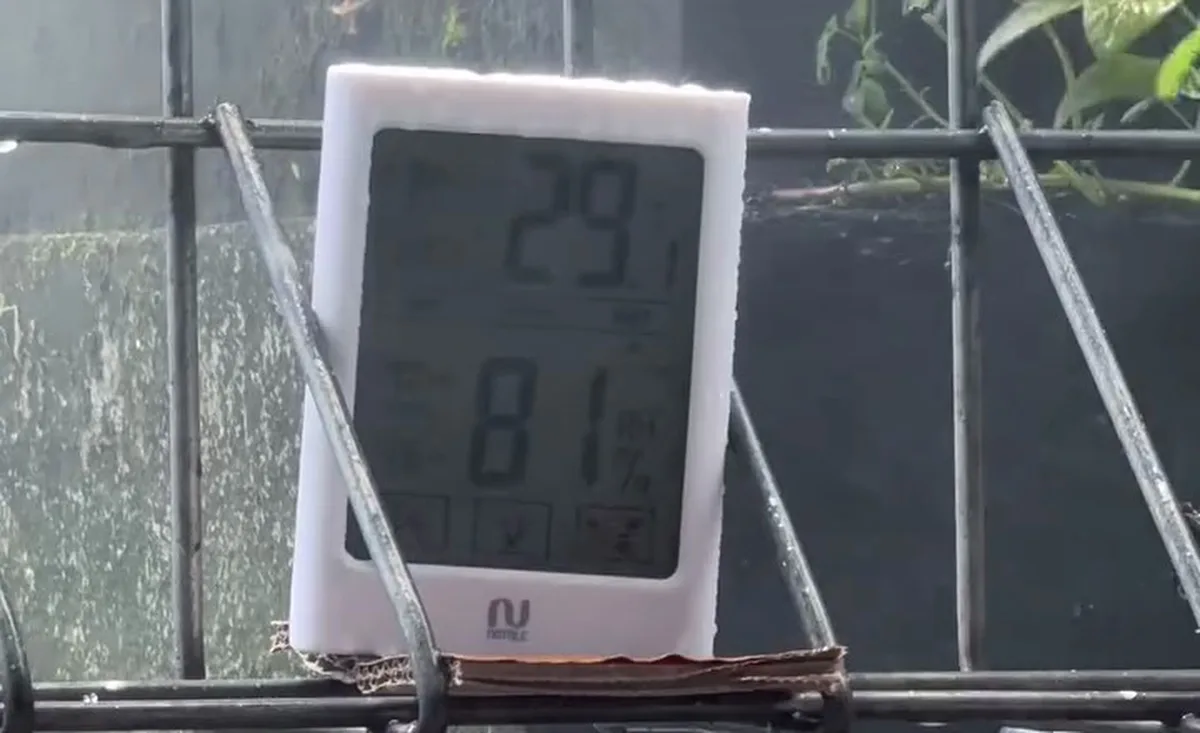
Of all Indonesia’s small agricultural businesses, oyster mushroom growing has the most naked relationship with humidity: a mushroom’s fruiting body is almost entirely water, and a growing house that drops below its humidity range stops producing — sometimes within hours. Every grower knows the ritual: wetting the floors, fogging with a backpack sprayer, hanging damp sacks — a manual war against dry air, several times a day, every day.
This article is about automating that war — and about the two most expensive humidity mistakes in a growing house.
Why mushrooms are this strict about humidity
Mushrooms have no protective skin the way plants do — the fruiting body releases water to the air continuously. In dry air, pinheads desiccate before developing, caps crack, and harvest weight drops along with its water content. The working range oyster growers use generally sits around 80–90% RH — exactly the range we deal with daily, usually with the opposite goal.
That’s the interesting inversion for us: in hospitality we manage humidity so nobody feels it; in a growing house, humidity is the product.
The two expensive mistakes
Mistake 1: coarse watering straight onto the bags. Water landing as droplets creates saturation points in the substrate and casing — and saturation points are an invitation to contamination: wild fungi and bacteria competing for the same medium. The same droplet physics we write about everywhere applies in reverse here: fine droplets raise the air’s RH without wetting surfaces — humidity climbs, the bags stay healthy.
Mistake 2: swinging humidity. Manual means waves: saturated after each watering, dry before the next. Those swings stress developing fruiting bodies. Per-zone sensor control — the same tier we install in industrial applications — holds a narrow band all day with no one present.
Planning cooling for your farm?
Send a photo or video of the barn on WhatsApp — we’ll size the system for your headcount and send a quote within a day.
Water quality: here it’s about the harvest, not just the nozzles
At a venue, bad water clogs nozzles. In a growing house the stakes double: water sprayed into the growing room’s air becomes part of the mushroom’s biological environment. Sediment and water left standing in lines aren’t merely technical problems — proper filtration and a fresh-flowing-water routine are part of the growing house’s own hygiene.
Scale: from a backyard house to a commercial facility
- A small house (hundreds of bags): honestly — a disciplined manual sprayer can still win on cost. A system earns its place when watering time starts eating working hours, or when the house gets left unattended.
- Several houses / thousands of bags: one machine with lines zoned per house replaces the all-day manual watering — and stabilises yields across houses.
- Commercial facilities: full sensor control on the same platform as our industrial installations — from Greenfields’ dairy plant to a Madiun warehouse.
Running costs follow our usual pattern: thousands of rupiah a day in electricity, water at 2–8 litres per minute while active — in a growing house, that water isn’t a cost but a production input.
The short version
Mushrooms demand exactly what we do best: stable high humidity with no wet surfaces. Fine mist holds 80–90% RH without saturating the bags, sensors erase the manual swings, and filtration protects the growing room’s hygiene — while the grower stops watering and starts managing.
Running a growing house whose yields swing with how diligently someone waters? Send photos, the bag count, and your city via WhatsApp — we’ll tell you honestly at what scale automation starts paying for itself.
Ready to cool your venue?
Chat on WhatsApp