
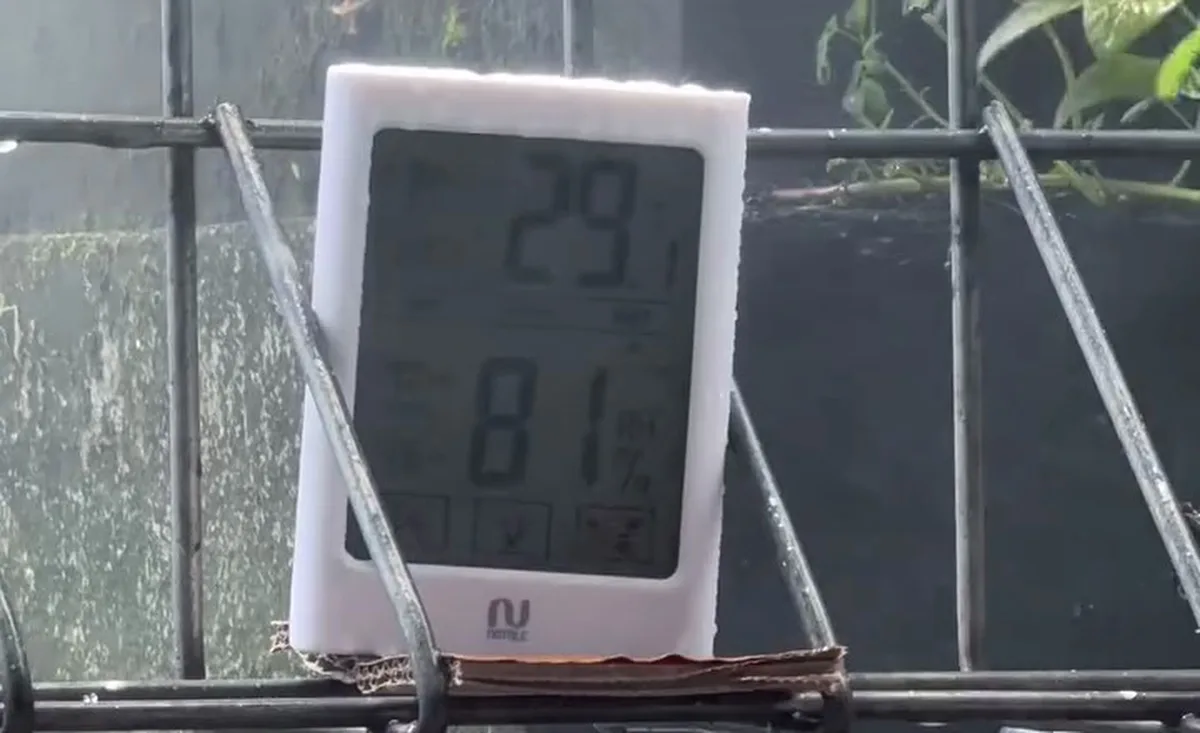
Search “does misting work in humidity” and the answers are discouraging. American vendors — based in Arizona and California — hedge: “evaporative cooling works best in dry climates.” Middle East suppliers, operating in desert air, agree. The implication for anyone in Indonesia, Singapore, Thailand or Florida seems obvious: don’t bother.
We run 600+ misting installations across Indonesia, where relative humidity sits between 70–90% most of the year. They work. This article explains why the dry-climate consensus doesn’t transfer, where the honest limits are, and what has to change in system design for humid air.
Why dry-climate vendors say no
Evaporative cooling extracts heat when water changes phase from liquid to vapour. The drier the air, the more vapour it can still absorb — so in Arizona at 20% humidity, even coarse mist evaporates readily and delivers dramatic temperature drops.
As humidity rises, the air’s remaining capacity for vapour shrinks. A vendor whose systems produce 50-micron droplets watches them stop evaporating somewhere around 60–70% humidity: droplets land on surfaces instead, everything gets wet, and cooling collapses. Their advice — “misting needs dry air” — is honest for their equipment.
What changes the equation: droplet size
Evaporation happens at the droplet’s surface. Halving a droplet’s diameter multiplies its surface-to-volume ratio — and a 10-micron droplet has enormously more evaporating surface per unit of water than a 50-micron one, plus a fraction of the mass that needs to become vapour before it lands.
Even at 80% relative humidity, air is not full: 20% of its vapour capacity is still available, and that headroom grows as the mist itself cools the air. Sub-10-micron droplets — produced at 70 bar of pressure — evaporate fast enough to use that remaining capacity before gravity wins. Coarser droplets never get the chance.
That’s the entire disagreement. It’s not climate marketing on either side — it’s a pressure and droplet-size specification. The physics are covered step by step in how mist cooling works.
Not sure what fits your space?
Send a photo of the area on WhatsApp — we’ll size the system and send a quote within a day. 600+ installations across Indonesia.
What our installations actually show
Across 600+ systems in Indonesian conditions — restaurant terraces, beach clubs, hotels, villas — high-pressure misting delivers up to 10°C of cooling in the misted zone, with tables, menus and floors staying dry. Venue results and measurements are collected in real results from mist cooling.
Three design differences make that possible in humid air:
- Pressure is non-negotiable. 70 bar producing sub-10-micron droplets. Mid-pressure “fog” systems at 15–30 bar that pass in dry climates leave wet furniture here. See low-pressure vs high-pressure mist.
- Nozzle layout is denser and zone-based. Humid air has less headroom per cubic metre, so coverage is engineered per zone rather than sprayed from a single line.
- Airflow is part of the design. Moving air continuously replaces near-saturated air around the mist with fresher air, keeping evaporation running.
The honest limits
We would rather tell you this than have you learn it after purchase:
- At the extreme top of humidity — during and right after rain, at 95%+ RH — the effect shrinks. There is simply little vapour capacity left. In practice this matters less than it sounds: the hours that kill terrace revenue are hot, sun-exposed midday hours, when humidity is at its daily low and evaporation headroom is at its high.
- Still, enclosed corners underperform. A misted zone needs air exchange. Fully wind-sheltered pockets need airflow added to the design.
- Wrong equipment fails completely. In humid air there is no margin for coarse droplets. A system that quotes no pressure figure will wet your furniture — the failure modes are catalogued in why misting systems fail in the tropics.
The short version
“Misting doesn’t work in humidity” is true for the low-pressure equipment most of the world sells, and false for sub-10-micron high-pressure systems designed for tropical air. The proof isn’t a lab claim — it’s 600+ working installations at 70–90% RH.
If you run a venue in a humid climate and want to know what’s realistic for your space: send a photo, the approximate area, and your city via WhatsApp. We’ll tell you what temperature drop to expect honestly — including the hours when it will and won’t be at its best.
Ready to cool your venue?
Chat on WhatsApp