
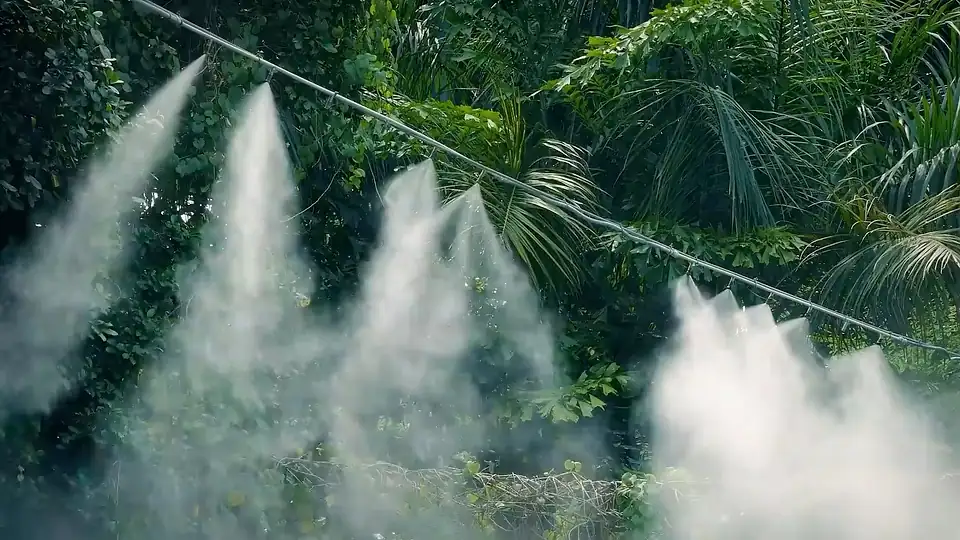
Mist cooling systems are increasingly common at restaurants, beach clubs, hotels, and event venues across Indonesia and Southeast Asia. They visibly work — walk into a mist-cooled terrace and the temperature difference is immediately noticeable. But the mechanism behind that temperature drop is not obvious, and understanding it explains why some systems work dramatically better than others.
This article covers the physics of how mist cooling works, why pressure is the single most important specification, and how the technology performs in tropical humidity.
The Core Principle: Flash Evaporation
Mist cooling operates on a thermodynamic process called evaporative cooling. When water transitions from liquid to vapor, it absorbs energy from its surroundings. That energy absorption is what lowers the air temperature.
The key number is the latent heat of vaporization. Every gram of water that evaporates absorbs approximately 2,400 joules of heat energy from the surrounding air. This is not a small amount — it is enough energy to raise the temperature of 2.4 grams of air by nearly 1,000 degrees Celsius if it were applied as heat instead of absorbed during evaporation.
A mist cooling system exploits this by creating an enormous number of tiny water droplets and dispersing them into the air. Each droplet evaporates rapidly, and each evaporation event pulls heat out of the surrounding atmosphere. Multiply this across millions of droplets per minute, and the cumulative cooling effect drops ambient temperature by 5-10 degrees Celsius across the treated zone.
Why Pressure Matters: 70 Bar vs. Low-Pressure Systems
Not all mist systems are the same. The pressure at which water is forced through the nozzle determines droplet size, and droplet size determines everything else.
High-pressure systems (60-80 bar) produce droplets in the 10-micron range. For reference, a human hair is about 70 microns wide. At 10 microns, a water droplet has an extremely high surface-area-to-volume ratio, which means it evaporates almost instantly upon contact with warm air. This is flash evaporation — the droplet transitions to vapor in fractions of a second.
Low-pressure systems (3-5 bar) — the kind sold as consumer garden misters — produce droplets of 50-200 microns. These larger droplets do not evaporate fast enough. They drift downward, land on surfaces, and wet everything they touch. Tables get damp. Guests get sprayed. Food gets misted. The cooling effect is weaker because a significant portion of the water lands as liquid rather than evaporating in the air where the cooling actually happens.
The difference is not incremental. It is the difference between a system that cools invisibly and one that makes a wet mess.
| Specification | High-Pressure (70 bar) | Low-Pressure (3-5 bar) |
|---|---|---|
| Droplet size | 10 microns | 50-200 microns |
| Evaporation speed | Fractions of a second | Seconds (many never evaporate) |
| Surface wetting | None | Significant |
| Temperature drop | Up to 10 degrees C | 2-4 degrees C |
| Guest comfort | Dry, invisible cooling | Damp, visible spray |
| Suitable for dining | Yes | No |
MistSystem operates at 70 bar with precision-machined nozzles that produce consistent 10-micron droplets. This is the pressure class used in professional hospitality installations worldwide.
Not sure what fits your space?
Send a photo of the area on WhatsApp — we’ll size the system and send a quote within a day. 600+ installations across Indonesia.
Why Tables and Guests Stay Dry
This is the question every venue owner asks: if you are spraying water, why does nothing get wet?
The answer is droplet physics. A 10-micron water droplet at 33 degrees Celsius ambient temperature evaporates in a fraction of a second. It transitions from liquid to vapor while still airborne, well above table height. By the time the air reaches guest level, it carries only water vapor — not liquid droplets. The cooling effect is delivered without any moisture landing on surfaces.
Compare this to a 100-micron droplet from a low-pressure system. That droplet takes 100 times longer to evaporate (evaporation time scales with the square of the droplet diameter). It falls under gravity before it can fully evaporate, landing on tables, chairs, plates, and guests as liquid water.
The nozzle height and spacing are also calibrated during installation. Mist lines are typically mounted 2.5-3.5 meters above ground level along pergolas, canopy edges, or cable runs. This gives the droplets sufficient air time to complete evaporation before reaching the occupied zone below.
Humidity: Does It Work in Tropical Climates?
Evaporative cooling is most effective in dry air, which raises a fair question for Indonesia, where relative humidity regularly sits between 70-85%. The physics is straightforward: higher humidity means the air already holds more water vapor, which slows evaporation rates.
However, high-pressure mist cooling remains effective in tropical humidity for several reasons:
The droplets are extremely small. At 10 microns, the surface area relative to volume is so large that evaporation happens even when humidity is high. The driving force (the difference between saturation vapor pressure and actual vapor pressure) is reduced but not eliminated.
Open-air environments help. Unlike enclosed spaces where humidity would build up rapidly, outdoor terraces, pool decks, and garden venues allow continuous air exchange. Humid air disperses naturally, and drier air replaces it. Wind and natural convection assist this process.
The temperature drop is still meaningful. In dry climates, mist cooling can achieve 15+ degree drops. In tropical humidity, the drop is typically 5-10 degrees Celsius. A 7-degree drop on a 34-degree day brings the perceived temperature to 27 degrees — the difference between guests leaving and guests ordering another round.
MistSystem has completed over 600 installations across Indonesia, the vast majority in Bali’s consistently humid climate. The systems perform reliably in conditions that venue owners initially expected would be problematic.
System Components
A high-pressure mist cooling installation consists of four main components:
High-pressure pump: The heart of the system. Takes municipal water pressure (2-4 bar) and raises it to 70 bar. MistSystem uses commercial-grade pumps rated for continuous operation in tropical conditions.
Stainless steel tubing: 6mm diameter stainless steel lines carry pressurized water from the pump to the nozzle points. Stainless steel is critical — brass or plastic tubing degrades under sustained high pressure and tropical humidity. The lines are rigid enough to maintain precise nozzle positioning along mounting structures.
Precision nozzles: Machined orifice nozzles with openings calibrated to produce 10-micron droplets at 70 bar operating pressure. Nozzle spacing is determined during installation based on the area dimensions and mounting height.
Control system: Timer and zone controls allow operators to activate cooling by area and schedule. Most installations run only during peak heat hours, though the operating cost is so low (IDR 2,000-5,000 per day) that many venues run continuously during business hours.
Energy Consumption
High-pressure mist cooling is dramatically more energy-efficient than any enclosed cooling alternative. The pump that drives the system draws a fraction of the power that air conditioning compressors require.
A typical installation covering 60-150 square meters costs IDR 2,000-5,000 per day in electricity. For comparison, a single split-unit AC running eight hours per day costs IDR 30,000-50,000 in electricity. Mist cooling delivers comparable or better perceived comfort at 90% lower energy cost — and it works in open-air spaces where AC cannot function at all.
What to Look for in a System
If you are evaluating mist cooling for a venue, the specifications that matter are:
- Operating pressure: 60 bar minimum. Below that, droplet size increases and surface wetting becomes a problem. MistSystem operates at 70 bar.
- Nozzle quality: Precision-machined nozzles maintain consistent droplet size. Cheap nozzles produce uneven spray patterns and clog frequently.
- Tubing material: Stainless steel, not plastic or brass. The system operates under extreme pressure in a corrosive tropical environment.
- Professional installation: Nozzle spacing, line routing, and mounting height all affect performance. This is not a DIY project for commercial venues.
Does it work in humid climates?
The most common follow-up question deserves its own answer: yes, with the right droplet size — the physics and the honest limits are in does mist cooling work in humid climates.
Next Step
MistSystem has installed 600+ high-pressure mist cooling systems across Indonesia, with 400+ in Bali alone. Systems start at IDR 15,200,000 for the MistPro 100 (up to 60 sqm), IDR 16,900,000 for the MistPro 200 (up to 150 sqm), and IDR 18,900,000 for the MistPro 300 (up to 300 sqm). All include stainless steel lines, professional installation, and a 1-year machine warranty.
For a free site assessment and fixed-price quote, contact us on WhatsApp: +62 851 9029 1717
Frequently asked questions
How much cooler does a misted terrace actually get?
Up to 10 degrees Celsius on an open terrace. The exact drop depends on humidity and airflow — drier, moving air evaporates mist faster and cools more.
Why don't the tables get wet?
At 70 bar the nozzles produce droplets under 10 microns, which evaporate in the air before they can land. Evaporation is also where the cooling comes from.
How much water and electricity does the system use?
2-8 litres of water per minute while actively misting, and roughly Rp 2,000-5,000 per day in electricity — about what a rice cooker uses.
Ready to cool your venue?
Chat on WhatsApp