
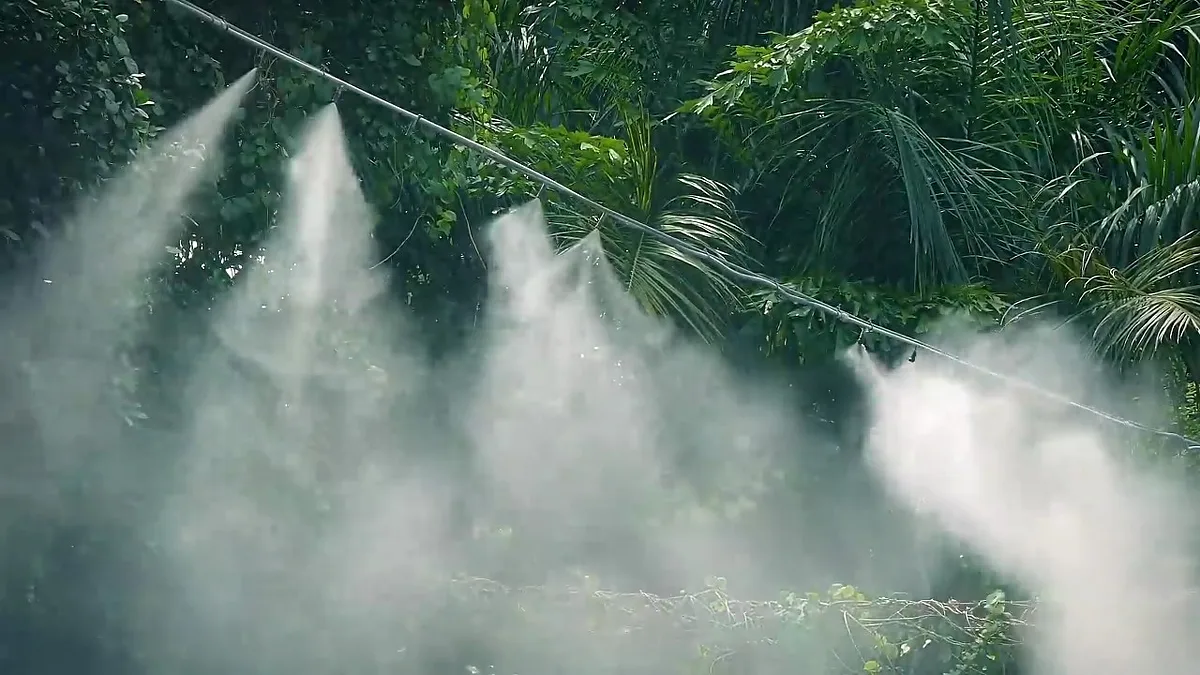
We regularly get called not to install a new system but to “look at why mine isn’t cooling” — and most of the patients are DIY builds from marketplace kits or self-assembled parts. Honestly: for a small terrace, installing it yourself is possible. But the mistakes repeat in an extremely predictable pattern.
Here are the seven we find most often — so if you take the DIY route anyway, you at least walk in with open eyes.
1. No filter at all
The number-one mistake by a wide margin. Cheap kits ship without filtration, tap water goes straight into the line — and nozzle orifices thinner than a hair clog within weeks. The owner concludes “misting is just bad”, when what’s bad is unfiltered water. A sediment filter ahead of the pump isn’t an accessory — it’s the system’s life support.
2. Guessed nozzle spacing
Too dense means wasted water and an over-wet zone; too sparse means hot corridors between cool spots. Correct spacing depends on pump pressure and mounting height — kits usually state neither. The safe principle: follow the nozzle manufacturer’s spacing spec exactly, and if there is no spec — that tells you something about the kit.
Not sure what fits your space?
Send a photo of the area on WhatsApp — we’ll size the system and send a quote within a day. 600+ installations across Indonesia.
3. The line mounted too low
Amateur logic: closer to people means cooler. Physics: droplets need fall distance to finish evaporating — a line at head height puts mist onto hair and shoulders before it can vanish. Mounting height is part of the evaporation calculation, not a matter of taste.
4. The pump in the wrong place
Under open sun (short life), next to a guest table (noise), at the lowest point with no drainage (puddles). A pump wants three things: shade, ventilation, and distance from people’s ears — pump placement is part of the design, not leftover space.
5. Garden hose as the line
Ordinary PVC hose survives low pressure for a while — then bulges, leaks at joints, and adds a plastic smell to the mist. At high pressure it’s immediately irrelevant. The right line is stainless — and specifically 316L, for reasons beyond looks.
6. Switch on and forget
DIY systems almost never come with a routine: no 2–4 week nozzle cleaning, no periodic runs through the rainy season. The result is predictable — the five failure modes arrive on schedule. Maintenance isn’t a premium option; it’s part of ownership.
7. The wrong scale from the start
The most expensive mistake: chaining kit after kit for an area that needed a system from day one. At some point — the maths is in the sizing guide — the total of kits, time and frustration passes the price of an installed package with a warranty. DIY makes sense under roughly 20 m²; above that, you’re doing someone else’s job with worse tools.
When DIY is genuinely fine — and when to call us
DIY is fine: a small home terrace, one short line, a kit with clear specs plus a filter, and the willingness to run the routine.
Call a professional: commercial areas (paying guests mean zero tolerance for damp and noise), multi-zone layouts, well water, or a build that has already failed once — reviewing and rescuing an existing assembly is often cheaper than starting over.
Is your DIY build not cooling, running wet, or making noise? Send a 10-second video of it running via WhatsApp — we diagnose from footage and tell you honestly: a small fix, a filtration upgrade, or time for a proper system.
Ready to cool your venue?
Chat on WhatsApp