
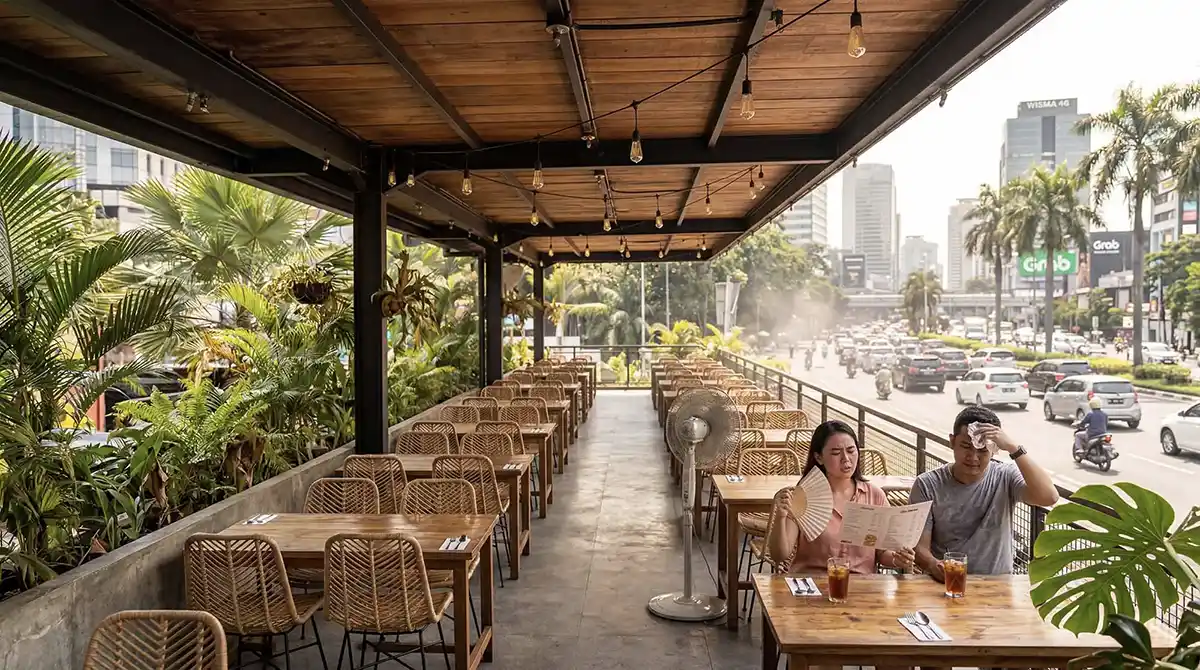
Air coolers are everywhere on Indonesian marketplaces: a box on wheels with a water tank, priced far below an AC unit, promising “AC-like cooling without refrigerant”. For a venue owner with a hot outdoor area, the question is fair: why not just buy an air cooler?
The short answer: air coolers and mist cooling use the same physics — but apply it in very different ways, and in Indonesia’s climate that difference decides the outcome.
How an air cooler works
An air cooler (evaporative cooler, “AC without freon”) is a fan that pulls air through a wet pad — a honeycomb panel soaked from a water tank. Water evaporates in the pad, absorbs heat, and the air coming out is cooler and more humid.
That’s where the unstated condition lives: evaporation only happens if the air can still hold more water vapour. The more humid the air, the less water evaporates — and the smaller the temperature drop. The same principle is covered in our evaporative cooling glossary entry.
Air coolers are designed for dry climates. In desert air with low humidity, they perform well. In Indonesia, where daily humidity typically sits between 70–90%, there is little evaporation headroom left — and the result is often just a stream of damp air, a few degrees cooler, within a short radius of the unit.
Two extra problems outdoors
First: cooled air doesn’t stay. An air cooler cools an airstream, not an area. Indoors, cool air accumulates. On an open terrace, the stream instantly mixes with an unlimited volume of hot air — the same reason outdoor air conditioning fails.
Second: humidity is added to the seating area. An air cooler’s output is saturated with water vapour. In an already-humid climate, adding humidity where guests sit makes the stickiness worse — skin can’t evaporate sweat into air that’s already full.
Not sure what fits your space?
Send a photo of the area on WhatsApp — we’ll size the system and send a quote within a day. 600+ installations across Indonesia.
Why mist cooling works in the same conditions
High-pressure mist cooling uses evaporation too — but moves it from the pad into the air itself. A 70-bar pump breaks water into droplets under 10 microns that evaporate in the air of the seating area, absorbing heat exactly where guests are.
The practical differences:
| Dimension | Air cooler | High-pressure mist cooling |
|---|---|---|
| Where evaporation happens | In a pad inside the unit | In the air, along the nozzle line |
| Coverage | Directional stream, short radius | The whole area under the nozzle line |
| Effect in humid air | Drops off sharply | Sub-10-micron droplets still evaporate |
| Humidity where guests sit | Rises noticeably | Controlled — the water fully evaporates |
| Surfaces | Dry (unit), damp (near stream) | Dry |
| Temperature drop | A few degrees, local | Up to 10°C, even across the area |
| Tank | Manual refills | Direct water connection |
That “up to 10°C” figure isn’t a dry-climate laboratory claim — it’s the result across our 600+ installations in Indonesian humidity. Why ultra-fine droplets keep evaporating at 80%+ relative humidity is explained in how mist cooling works.
When an air cooler still makes sense
To be honest, it has its cases:
- Semi-enclosed, ventilated spaces: a workshop, an open kitchen, a small warehouse — where a stream of cool damp air beats nothing and aesthetics don’t matter.
- A single work station: one person in front of the unit, not a guest area.
- A very tight budget paired with realistic expectations of the result.
For commercial guest areas — restaurant terraces, cafes, rooftops — where people pay to sit comfortably and extra humidity is felt immediately, an air cooler is the wrong tool for the job. A full comparison of outdoor cooling options is in mist cooling vs AC.
The short version
Air coolers work through pad evaporation and are built for dry air — in Indonesian humidity their effect is small, local, and adds stickiness to the seating area. Mist cooling moves evaporation into the air with sub-10-micron droplets, so it keeps working in high humidity and cools the whole area evenly without wetting a single surface.
Not sure which tool fits your area? Send a photo, approximate size, and your city via WhatsApp — we’ll answer honestly, including when the answer is “an air cooler is enough for your case”.
Ready to cool your venue?
Chat on WhatsApp