
Restaurant Cooling in Seminyak and Canggu: How Bali's Hottest F&B Corridor Beats the Heat
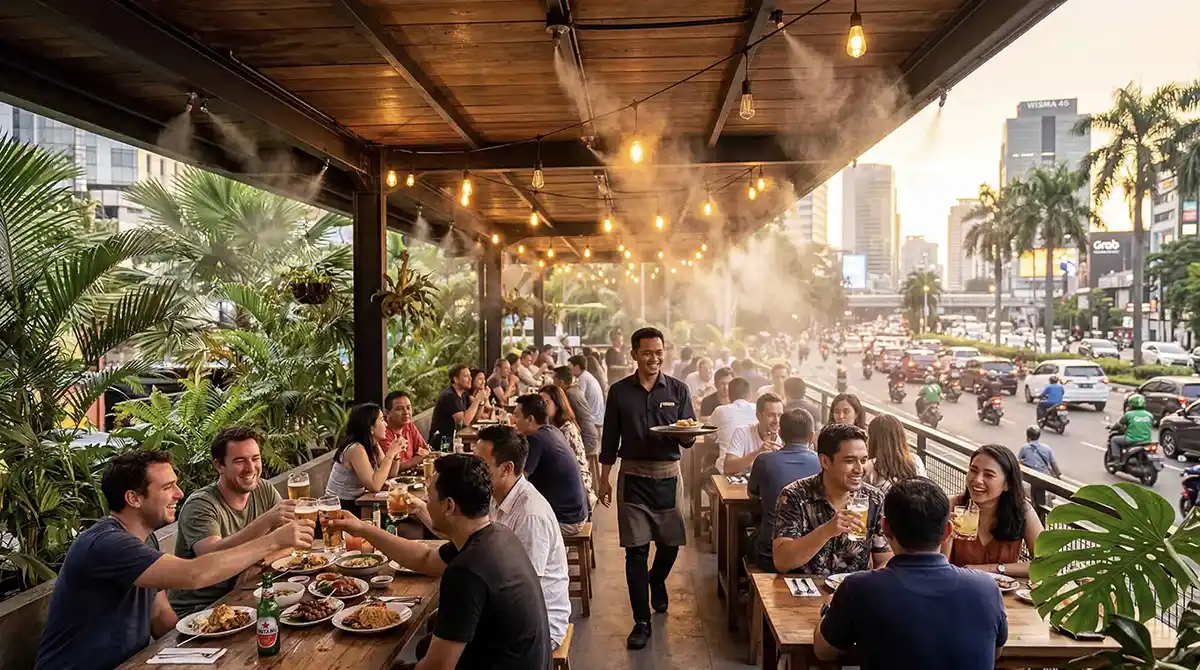
The Seminyak-Canggu corridor is the most competitive F&B strip in Bali. From Eat Street and Oberoi in Seminyak to Batu Bolong, Berawa, and Echo Beach in Canggu, hundreds of restaurants, cafes, and beach clubs fight for the same crowd every day. The venues that fill tables consistently share one thing: guests stay comfortable outside.
Why This Corridor Has a Unique Heat Problem
Seminyak and Canggu sit on Bali’s southwest coast. Coastal humidity regularly hits 80-90%, and midday temperatures reach 33-35C from March through November. Add the urban heat island effect from rapid concrete development — especially in Canggu’s Berawa and Pererenan zones — and outdoor terraces become unbearable between 11:00 and 16:00.
That is exactly when lunch revenue should peak. Instead, guests crowd into air-conditioned interiors or skip the venue entirely.
The Numbers Behind Empty Terraces
A typical Seminyak restaurant with 40 outdoor covers loses 20-30 seats during peak heat hours. At an average check of IDR 250,000-400,000 per person, that is IDR 5-12 million in missed revenue every afternoon. Over a month, the gap adds up to IDR 150-360 million — far more than the cost of solving the problem.
How Mist Cooling Changes the Economics
High-pressure mist systems push water through 10-micron nozzles at 70 bar. The droplets evaporate before reaching skin or furniture, pulling heat from the air. The result: an 8-12C temperature drop across the terrace.
For a typical Seminyak restaurant terrace of 60-80 square meters, the MistPro 100 (IDR 15,200,000) or MistPro 200 (starting at IDR 16,900,000) covers the area completely. Energy cost runs IDR 2,000-5,000 per day — roughly 90% less than extending air conditioning outdoors.
Seminyak: Established Venues Upgrading
Seminyak’s dining scene is mature. Venues around Ku De Ta, Potato Head, and Petitenget have high fit-out standards and premium pricing. Guests expect comfort. Mist cooling integrates cleanly into existing pergola and canopy structures without disrupting the design language these venues have invested in. The 6mm stainless steel lines resist salt corrosion from the coastal air.
Canggu: New Builds Getting It Right from Day One
Canggu’s growth is explosive. New venues open weekly along Batu Bolong and the Berawa strip. Smart operators now spec mist cooling into their initial build rather than retrofitting later. Installation takes one day for most setups, but planning lines into the roof structure during construction saves time and delivers a cleaner look.
Not sure what fits your space?
Send a photo of the area on WhatsApp — we’ll size the system and send a quote within a day. 600+ installations across Indonesia.
Venues Already Using MistSystem in This Corridor
Over 400 MistSystem installations are active in Bali, with a significant concentration in the Seminyak-Canggu-Kerobokan triangle. Clients in the broader area include beach clubs, hotel restaurants, and standalone dining concepts. The pattern is consistent: venues that install mist cooling report filling outdoor sections during hours that were previously dead.
Choosing the Right System for Your Venue
| Venue Type | Typical Area | Recommended System | Price |
|---|---|---|---|
| Small cafe terrace | Up to 60 m2 | MistPro 100 | IDR 15,200,000 |
| Mid-size restaurant | 60-150 m2 | MistPro 200 | IDR 16,900,000 |
| Large beach club / multi-zone | Up to 300 m2 | MistPro 300 | IDR 18,900,000 |
All systems include 6mm stainless steel lines and a 1-year machine warranty. Installation typically completes in one day.
The Competitive Reality
When the restaurant next door has a cool terrace and yours does not, guests notice. In a corridor this dense, comfort is not a luxury — it is a conversion factor. The investment pays back in 1-4 weeks of recovered outdoor revenue.
Comparing options across the island first? Start with the Bali outdoor cooling guide. And if you operate a venue in Seminyak, Canggu, Kerobokan, or Berawa and want to see what mist cooling looks like for your specific layout, reach out for a free site assessment.
Get a free quote: +62 851 9029 1717
Ready to cool your venue?
Chat on WhatsApp