
Bali Restaurant Trends 2026: Outdoor-First Design, Sustainability, and the Tech Reshaping F&B
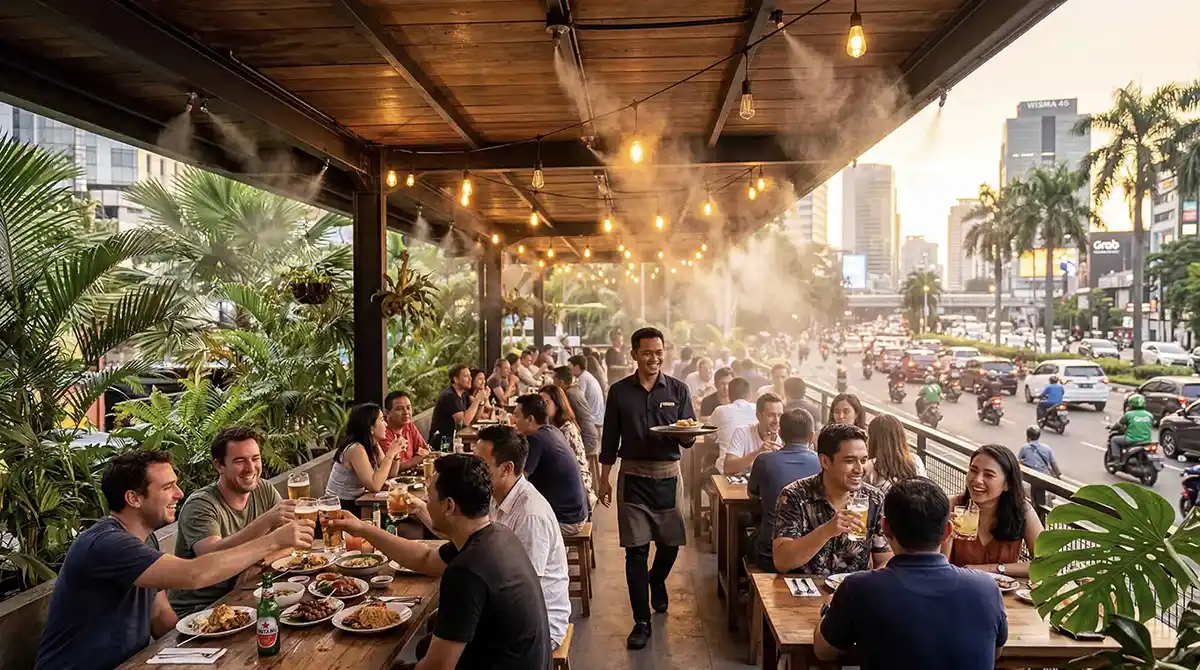
Bali’s food and beverage sector has changed more in the past three years than in the previous decade. International tourist arrivals surpassed pre-COVID levels in 2025, domestic tourism from Jakarta, Surabaya, and Medan is at record highs, and the digital nomad population has settled into a permanent fixture of the island’s economy. The result is a market that supports more venues, at more price points, in more locations than ever before.
But the rules of the game have shifted. What worked in 2019 does not necessarily work in 2026. Here are the trends that are actually reshaping how restaurants operate, invest, and compete in Bali this year.
Outdoor-First Is Now the Default
The most significant structural shift in Bali’s restaurant design is that outdoor dining has moved from an add-on to the primary revenue space. New venues being built in Canggu, Pererenan, and the Tabanan coast are allocating 60-80% of their total seating capacity to outdoor and semi-outdoor areas. Indoor space is shrinking to kitchen, bar, and a small air-conditioned zone for the hottest hours.
This is driven by three forces:
Guest preference. Both international tourists and Indonesian domestic visitors overwhelmingly prefer outdoor seating in Bali. The tropical setting is the product — enclosing it behind glass walls defeats the purpose of being on the island.
Construction economics. Open-air structures cost 30-50% less per square meter to build than fully enclosed, air-conditioned spaces. No sealed walls, no ducting, no compressor units — just roof structure, flooring, and furniture.
Social media dynamics. Outdoor spaces with natural light, greenery, and views generate dramatically more user-generated content than interiors. For a market where Instagram and TikTok drive a significant share of discovery, this is a direct competitive advantage.
The challenge is obvious: outdoor dining in a tropical climate requires solving the heat problem. Venues that have invested in high-pressure mist cooling systems report that their outdoor sections stay full through the 11 a.m. to 4 p.m. window that empties uncooled terraces. The technology has moved from a luxury add-on to essential infrastructure for any venue taking outdoor dining seriously.
Sustainability as a Business Requirement
Sustainability in Bali’s restaurant scene has graduated from a marketing angle to an operational requirement. The Bali provincial government’s single-use plastic ban (Pergub No. 97/2018) is now actively enforced. Guests — particularly international visitors — increasingly make dining choices based on visible environmental practices.
What this looks like in practice for 2026:
- Energy efficiency is a real cost differentiator. Venues are choosing cooling solutions based on energy consumption, not just upfront cost. A mist cooling system running on Rp 2,000-5,000 per day versus an AC system consuming Rp 50,000-150,000 per day is a meaningful difference in monthly operating costs — and a sustainability story that resonates with guests.
- Local sourcing has moved beyond produce. Furniture, construction materials, tableware, and decor from Balinese artisans reduce shipping costs, support the local economy, and create a more authentic guest experience.
- Waste management systems — composting, grease trap management, recycling — are being built into venue design from the start rather than retrofitted.
Not sure what fits your space?
Send a photo of the area on WhatsApp — we’ll size the system and send a quote within a day. 600+ installations across Indonesia.
New Geography: Where the Growth Is Happening
The traditional restaurant corridors — Seminyak, central Canggu, Ubud center — are saturated. Rents are at peak levels and competition for staff is intense. The growth in 2026 is happening in the next ring of development:
Canggu north and Pererenan. The area between Batu Bolong and Echo Beach has expanded inland and northward. Pererenan in particular has attracted a wave of mid-range to premium restaurants serving the growing resident population of remote workers and long-stay visitors.
Tabanan coast. Seseh, Cemagi, and the coastline stretching toward Tanah Lot are seeing significant new development. Lower rents, larger plots, and ocean frontage that Seminyak and Canggu can no longer offer. The infrastructure is catching up — road improvements and new co-working spaces are pulling traffic west.
Sanur revival. Long considered quieter and older-skewing, Sanur is experiencing a revival driven by families, wellness tourists, and a community of entrepreneurs who prefer its calmer pace. New restaurants are replacing dated venues with contemporary outdoor concepts.
East Bali. Amed, Candidasa, and the eastern coast are attracting investment from operators priced out of the south. Tourist numbers to eastern Bali have grown steadily as road access improves and dive tourism expands.
Technology Adoption Is Accelerating
Bali’s F&B sector historically lagged on technology adoption. That gap is closing rapidly in 2026.
POS and operations. Cloud-based POS systems (Moka, Pawoon, ESB) are now standard even in small cafes. Real-time inventory tracking, staff scheduling, and sales analytics that were once available only to large chains are accessible to single-location venues for under Rp 500,000/month.
Online ordering and delivery. GoFood and GrabFood penetration continues to grow, but the more significant trend is restaurants building their own direct ordering through WhatsApp Business and simple web ordering pages, avoiding the 20-30% commission from aggregator platforms.
Climate management technology. This is perhaps the most impactful technology shift for venue operations. High-pressure mist cooling systems have moved from rare to common among serious outdoor venues. The current generation operates at 70 bar pressure with 10-micron droplets, achieving 8-10 degree Celsius temperature drops with energy consumption of Rp 2,000-5,000 per day. For comparison, air conditioning a comparable space would cost Rp 50,000-150,000 per day and require enclosed walls that defeat the outdoor concept.
Guest experience tech. QR code menus, digital payment (QRIS), automated reservation systems, and CRM tools for repeat guest recognition are all becoming baseline expectations rather than differentiators.
Experiential Dining and the Premium Shift
Bali’s restaurant market is bifurcating. The mid-range is getting squeezed as guests gravitate toward either value-driven casual dining or premium experiential concepts where the setting and experience justify a higher price point.
The premium venues winning in 2026 share common elements: dramatic outdoor settings (clifftop, beachfront, rice field), multi-sensory design (lighting, sound, scent, temperature), curated menus with story and provenance, and impeccable comfort despite being open-air. These venues charge Rp 500,000-1,500,000 per person and maintain waitlists because the total experience — not just the food — is the draw.
For these venues, every infrastructure decision supports the experience. Climate control is not about preventing discomfort — it is about creating a specific atmospheric quality where guests feel the tropical warmth without the tropical heat.
What This Means for Operators
If you are planning a new venue or upgrading an existing one in Bali in 2026, the priorities are clear:
- Design outdoor-first. Allocate 60% or more of your capacity to outdoor and semi-outdoor space.
- Solve the heat problem before opening. Mist cooling, shade architecture, and airflow design are not finishing touches — they determine whether your outdoor space generates revenue through the afternoon.
- Build sustainability into operations, not just marketing. Energy-efficient cooling, local sourcing, and waste management are operational advantages that also resonate with guests.
- Invest in technology that reduces operating costs and improves guest experience. The ROI on POS, climate management, and direct ordering tools is measured in months, not years.
MistSystem has installed cooling for over 600 venues across Indonesia, including beach clubs, hotel restaurants, cafes, and food courts in Bali, Jakarta, and Surabaya. Systems range from the MistPro 100 (up to 60 sqm, Rp 15,200,000) to the MistPro 300 (up to 300 sqm, Rp 18,900,000).
Talk to us about your venue: +62 851 9029 1717
Ready to cool your venue?
Chat on WhatsApp