
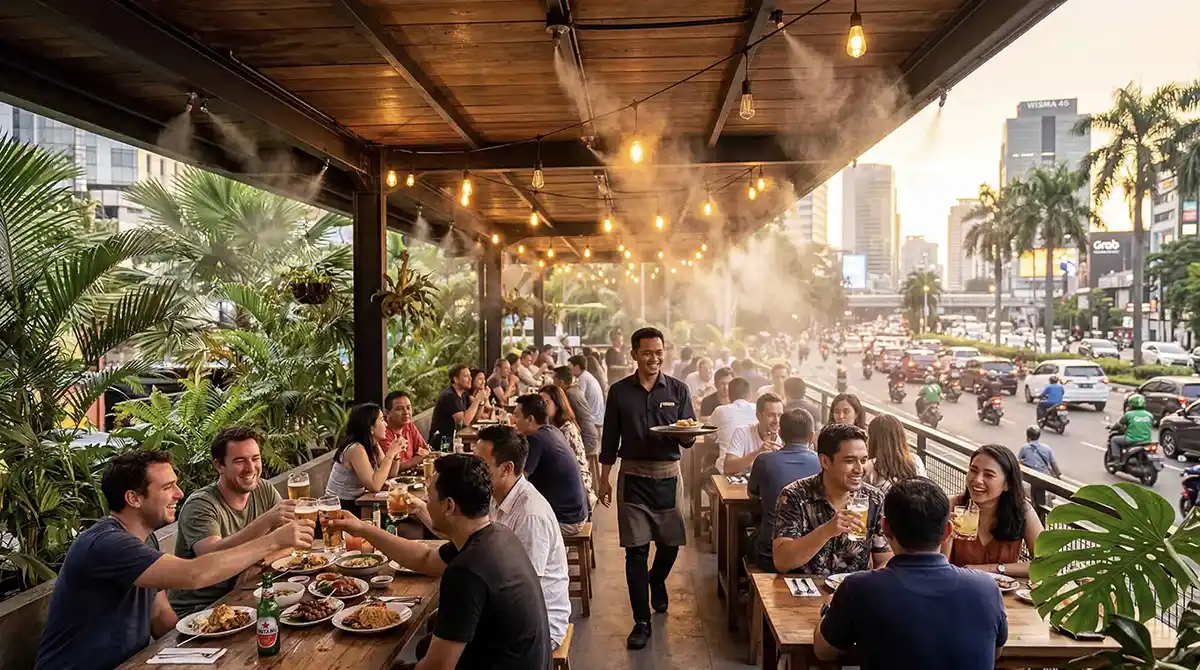
Lombok is no longer Bali’s quiet neighbor. The island has entered a sustained growth phase driven by the Mandalika SEZ development, improved airport infrastructure, and a deliberate government push to position it as Indonesia’s next premium tourism destination. Hotel and resort investment is accelerating across the island’s south and west coasts, and the dining scene is scaling to match.
But Lombok’s climate does not negotiate. Daytime temperatures hold steady at 30-33 degrees Celsius year-round, with coastal humidity regularly exceeding 80%. For an island where virtually every hospitality venue — from beachfront restaurants to hillside eco-lodges — relies on open-air dining as its primary format, outdoor cooling is not an amenity. It is infrastructure.
Lombok’s Hospitality Landscape
Senggigi
Lombok’s established tourism corridor runs along the west coast from Senggigi to Mangsit. Resorts and restaurants here cater to a mix of package tourists, independent travelers, and a growing base of repeat visitors. Dining formats include beachfront restaurants, poolside bars, and hillside venues with ocean views. Most were built 10-20 years ago with minimal outdoor climate management — shade structures and ceiling fans were considered sufficient.
They are no longer sufficient. As guest expectations rise with the influx of travelers who benchmark against Bali’s hospitality standards, venues that feel uncomfortably hot lose reviews, repeat visits, and direct bookings to competitors who have invested in comfort.
Kuta Lombok and Mandalika
The southern coast around Kuta Lombok is the epicenter of new development. The Mandalika Special Economic Zone has brought international hotel brands, and independent boutique resorts and restaurants are filling the spaces between them. This area has a distinct advantage: most venues are being built from scratch, which means cooling infrastructure can be designed in rather than retrofitted.
The climate here is slightly drier than Senggigi, with stronger coastal winds, but afternoon temperatures still reach 32-33 degrees. The open, exposed terrain offers little natural shade, and many venues are positioned for sunset views that mean direct western sun exposure during evening service.
Gili Islands
Gili Trawangan, Gili Air, and Gili Meno collectively host hundreds of beachfront bars, restaurants, and small resort dining areas. The no-motorized-vehicles policy on the Gilis creates a unique atmosphere but also means no conventional air conditioning infrastructure in many locations. Power comes from generators or limited grid supply, making energy-efficient cooling not just preferable but necessary.
Beach restaurants on the Gilis face the most extreme version of the heat challenge: full sun exposure, reflected heat from sand, minimal natural shade, and guests who are already warm from the beach and expecting their dining experience to provide relief.
Why Standard Solutions Fall Short
Air Conditioning: Wrong Tool for Open-Air
Enclosed AC only works in sealed spaces. Lombok’s best dining experiences are definitionally open-air — ocean breezes, sunset views, tropical garden settings. Enclosing these spaces to run AC destroys the product. Some venues attempt spot cooling with portable AC units on terraces, which wastes energy, generates noise, and produces minimal temperature reduction in open environments.
Fans: Air Movement Without Temperature Change
Ceiling fans and standing fans create perceived cooling through air movement across skin, but they do not lower the ambient temperature. At 33 degrees with 80% humidity, a fan blows hot, humid air across your guests. It is better than nothing, but it is not a solution. Guests still feel overheated, food still wilts on plates, and staff still work in conditions that reduce service quality.
Large Shade Structures: Necessary but Not Sufficient
Shade reduces radiant heat from direct sun but does nothing about ambient air temperature. A shaded terrace at 32 degrees is still a 32-degree terrace. Shade is a prerequisite for outdoor comfort, not a complete solution.
Not sure what fits your space?
Send a photo of the area on WhatsApp — we’ll size the system and send a quote within a day. 600+ installations across Indonesia.
How Mist Cooling Solves Lombok’s Heat Problem
High-pressure mist cooling at 70 bar pushes water through precision nozzles that produce 10-micron droplets — small enough to evaporate on contact with warm air, never reaching surfaces or guests. The evaporation process absorbs heat energy from the surrounding air, dropping ambient temperature by up to 10 degrees Celsius.
A beachfront restaurant terrace at 32 degrees becomes a 24-degree dining environment. Guests stay longer, order more, and leave better reviews. Staff work in sustainable conditions. Food presentation holds up. The venue operates at full capacity during hours that were previously written off as too hot for outdoor service.
Energy consumption is minimal: Rp 2,000-5,000 per day. For Gili Island venues running on generator power, this efficiency matters enormously. A mist cooling system uses roughly 90% less electricity than any AC alternative, making it viable even where power infrastructure is limited.
System Sizing for Lombok Venues
| Model | Coverage | Price | Best For |
|---|---|---|---|
| MistPro 100 | Up to 60 sqm | Rp 15,200,000 | Gili beach bar, small poolside dining area |
| MistPro 200 | Up to 150 sqm | Rp 16,900,000 | Resort restaurant terrace, boutique hotel dining |
| MistPro 300 | Up to 300 sqm | Rp 18,900,000 | Large beachfront restaurant, resort common area |
All systems use 6mm stainless steel lines that resist salt-air corrosion — critical for coastal Lombok installations. Nozzle lines mount along existing pergolas, timber beams, shade sail frameworks, or dedicated cable runs. The hardware is compact enough to integrate into any architectural style, from the rustic bamboo builds common on the Gilis to the polished resort designs going up in Mandalika.
Every installation includes a 1-year machine warranty.
ROI for Lombok Hospitality
Resort restaurants in Senggigi and Kuta Lombok typically operate with average guest spend of Rp 150,000-350,000. A venue with 50 outdoor seats that recovers even 12 lost covers per day during the 11 a.m. to 3 p.m. heat window generates Rp 1.8-4.2M in daily incremental revenue.
A MistPro 200 at Rp 16,900,000 pays for itself within one to two weeks of full operation. Annual ROI ranges from 15:1 to 30:1 depending on venue pricing and recovered capacity.
For Gili Island venues with tighter margins but higher volume, the MistPro 100 at Rp 15,200,000 covering a 40-60 sqm beachfront section generates payback in under three weeks at typical Gili pricing.
Timing: Build It In, Not After
Lombok’s hospitality sector is in a construction phase. New resorts, restaurants, and eco-lodges are being designed and built right now across Mandalika, Kuta, and the southwest coast. The most cost-effective approach is to include mist cooling in the venue’s initial design — running lines during construction costs a fraction of retrofitting after the build is complete.
For existing venues in Senggigi and the Gilis, retrofit installation is straightforward. MistSystem’s stainless steel lines attach to existing structures with minimal modification, and installation typically completes within one to two days.
Get Started
MistSystem has completed 600+ installations across Indonesia, including coastal and island environments with conditions identical to Lombok. Contact us for a free site assessment and system recommendation matched to your venue.
WhatsApp: +62 851 9029 1717
Ready to cool your venue?
Chat on WhatsApp