
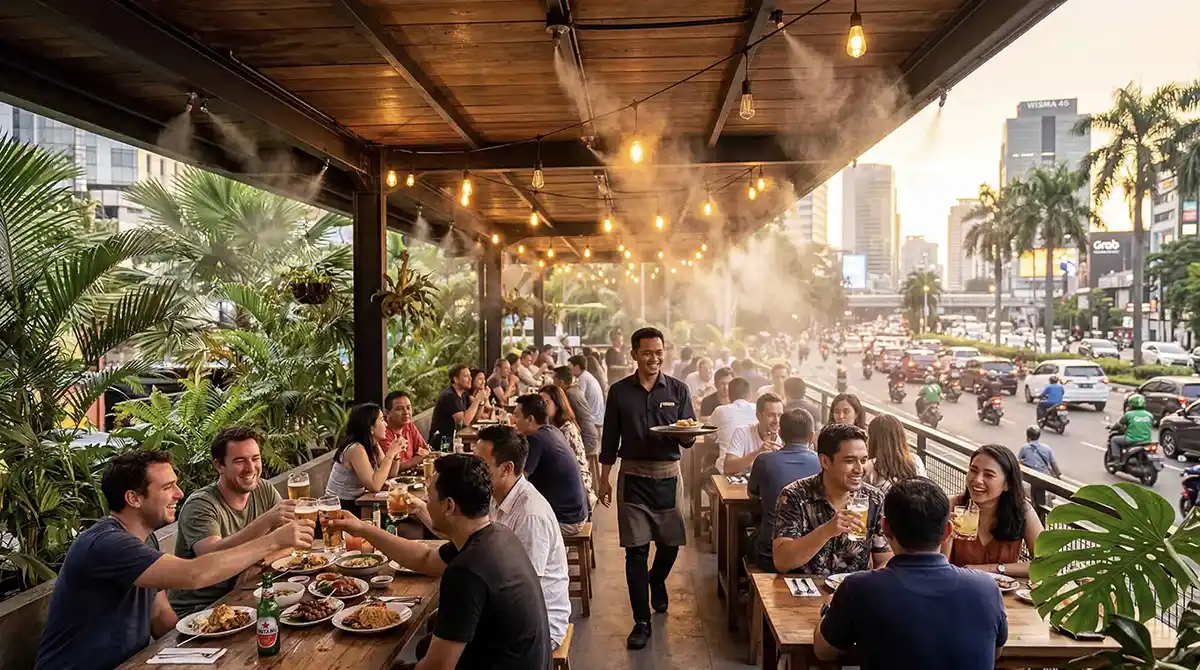
Bandung is Indonesia’s undisputed cafe capital. The city has more cafes per capita than Jakarta, Bali, or Yogyakarta, and the culture around them is deeply embedded in how Bandung residents socialize, work, and spend weekends. From third-wave coffee roasters in Dago to heritage-building conversions on Jalan Braga, outdoor seating is central to almost every concept.
The assumption many operators make is that Bandung’s highland elevation — 768 meters above sea level — means heat is not a problem. That assumption costs revenue. Daytime temperatures regularly hit 28-32 degrees Celsius between 10 a.m. and 3 p.m., and when your terrace faces the afternoon sun, guests relocate indoors or leave entirely. For a city where outdoor ambiance is the product, losing terrace covers during peak hours is a direct hit to the bottom line.
Bandung’s Climate: Cooler Than the Coast, Still Too Hot for Comfort
Bandung sits in a highland basin surrounded by volcanic peaks. Morning temperatures are pleasant — 20-24 degrees Celsius — which is why the city earned its reputation as a cool retreat from Jakarta. But by midday, direct sun exposure on unshaded surfaces pushes perceived temperatures well above comfort levels, especially on concrete and stone terraces that absorb and radiate heat.
The other factor operators underestimate is UV intensity. At 768 meters, UV radiation is measurably stronger than at sea level. Guests feel the sun more aggressively even when the air temperature reads lower than a coastal city. Shade alone reduces the problem but does not solve it. A shaded terrace at 30 degrees Celsius with no air movement still feels oppressive after 20 minutes.
District-by-District: Where Cooling Matters Most
Dago and Upper Dago
The highest-traffic cafe corridor in Bandung runs along Jalan Ir. H. Juanda and up into Dago Atas. Venues here range from compact coffee shops to sprawling multi-level garden cafes built into hillside terrain. Many Dago venues rely on elevation and tree cover for natural cooling, which works until the dry season strips canopy density and afternoon sun hits exposed terraces directly. Venues with 40+ outdoor seats report significant midday drop-offs during June through September.
Braga and City Center
Jalan Braga’s heritage corridor features colonial-era buildings converted into cafes and restaurants. Outdoor seating here is typically street-facing — tables on sidewalks or in narrow courtyard spaces between buildings. The urban heat island effect raises temperatures 2-3 degrees above surrounding areas, and the narrow street orientation traps hot air. Fans help with air movement but do not lower the actual temperature.
Buah Batu and South Bandung
The Buah Batu corridor and surrounding areas like Batununggal have seen rapid cafe growth since 2023. Newer builds here tend to feature purpose-designed outdoor spaces — rooftop sections, garden terraces, and semi-open pavilions. These venues have more design flexibility than the heritage buildings on Braga, but many were built without active cooling infrastructure and are retrofitting as they discover the midday revenue gap.
Setiabudi and North Bandung
Venues along Jalan Setiabudi and toward Lembang benefit from slightly cooler temperatures due to higher elevation, but also attract weekend crowds from Jakarta who expect a comfortable outdoor experience. The volume of weekend visitors means any loss of terrace capacity during peak hours has an outsized revenue impact.
Not sure what fits your space?
Send a photo of the area on WhatsApp — we’ll size the system and send a quote within a day. 600+ installations across Indonesia.
The Revenue Problem: Empty Terraces at Peak Hours
A 60-seat cafe in Dago with 30 outdoor seats that loses terrace occupancy from 11 a.m. to 3 p.m. is effectively operating as a 30-seat cafe during lunch service. If average spend per guest is Rp 75,000-120,000, the math is straightforward: losing 20 terrace covers during a four-hour peak window costs Rp 1.5-2.4M per day. Over a month, that is Rp 45-72M in potential revenue that walks out the door — or never walks in.
The problem compounds on weekends, when Bandung cafes see 2-3x weekday traffic and outdoor seating is the primary draw for visitors from Jakarta looking for an experience they cannot get at home.
Why Mist Cooling Works for Bandung Cafes
High-pressure mist cooling operates at 70 bar, pushing water through nozzles that produce 10-micron droplets. At that size, the water evaporates almost instantly on contact with warm air, dropping the ambient temperature by up to 10 degrees Celsius without wetting surfaces, food, or guests.
Bandung’s climate makes mist cooling particularly effective. The city’s relative humidity is lower than coastal cities like Jakarta or Bali during dry months, which means faster evaporation and more efficient cooling. A terrace at 31 degrees Celsius drops to 23-25 degrees — matching Bandung’s comfortable morning temperatures and eliminating any reason for guests to move inside.
The energy cost is negligible: Rp 2,000-5,000 per day for a system covering a full terrace. Compare that to attempting to cool outdoor space with industrial fans (Rp 15,000-30,000/day in electricity, no temperature reduction) or the Rp 45-72M monthly revenue loss from empty seats.
System Sizing for Bandung Cafes
MistSystem offers three configurations matched to typical Bandung cafe formats:
| Model | Coverage | Price | Best For |
|---|---|---|---|
| MistPro 100 | Up to 60 sqm | Rp 15,200,000 | Small terrace, Braga sidewalk seating |
| MistPro 200 | Up to 150 sqm | Rp 16,900,000 | Mid-size garden cafe, rooftop section |
| MistPro 300 | Up to 300 sqm | Rp 18,900,000 | Large multi-level venue, Dago hillside cafe |
Installation uses 6mm stainless steel lines that mount along existing pergolas, canopy edges, or cable runs. The nozzles are small enough to blend into any design — from Braga’s heritage facades to the industrial-modern builds common in Buah Batu. All systems include a 1-year machine warranty.
ROI Calculation
A mid-size Dago cafe investing Rp 16,900,000 in a MistPro 200 that recovers even 15 additional covers per day at Rp 80,000 average spend generates Rp 1,200,000 in daily incremental revenue. The system pays for itself in under two weeks. Over 12 months, the return exceeds 25:1 on the equipment investment.
Even conservative estimates — 8 additional covers per day at Rp 60,000 — produce a payback period under five weeks and an annual return above 10:1.
Getting Started
MistSystem has completed 600+ installations across Indonesia, including venues in highland climates similar to Bandung’s. The process starts with a site assessment to determine optimal nozzle placement based on your terrace layout, sun exposure, and seating configuration.
Contact MistSystem for a free consultation and site assessment: +62 851 9029 1717
Ready to cool your venue?
Chat on WhatsApp