
Every misting vendor — us included — writes “cools by up to 10°C”. The honest word in that sentence is “up to”, and buyers deserve to know what it hides: real results move within a range, and that range is set by conditions that can be explained.
This article unpacks the “up to”, so you know exactly what you’ll feel in your space — before you pay.
Where the temperature drop comes from
Mist cooling is evaporation: every gram of water that becomes vapour absorbs heat from the air. How much can evaporate — and therefore how many degrees drop — comes down to one question: how much vapour headroom is left in the air?
That’s why the same system delivers different results at different hours of the same day. The machine hasn’t changed — the air has.
The best conditions arrive exactly when you need them
This is the pleasant symmetry of evaporation physics: the biggest drop happens precisely at the hottest time. Blazing midday from 12 to 3 is when relative humidity sits at its daily low — hot air is “hungry” for vapour, mist evaporates aggressively, and this is where the numbers approach 10°C.
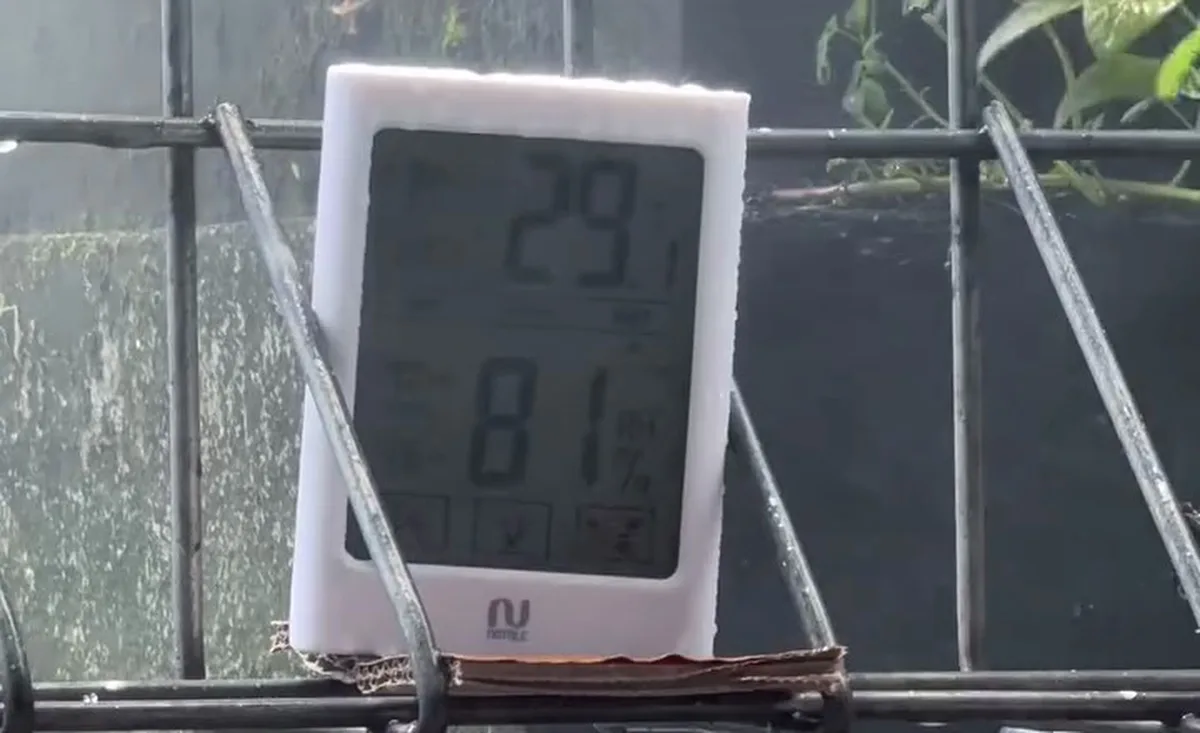
Data recorded at our installations by clients themselves: 34°C dropping to 26.5–27°C within minutes — a measured 7–7.5°C drop, in real Indonesian midday conditions.
Not sure what fits your space?
Send a photo of the area on WhatsApp — we’ll size the system and send a quote within a day. 600+ installations across Indonesia.
The conditions that trim the result — and by how much
Peak humidity (right after rain, damp evenings): little vapour headroom remains; the drop shrinks to a few degrees. The good news: in those conditions the air usually isn’t at peak heat anyway. The full humidity explanation is here.
Strong wind without a design that accounts for it: mist gets pushed out of the zone before it finishes evaporating where intended. That’s not a physics limit — it’s zone design work: windward lines, denser nozzles.
Zones with no shade at all: mist cools the air, but direct sun heats your skin through radiation — two different channels. Mist plus shade is the pairing that delivers the full number; shade always comes first.
An ageing, unmaintained system: partially clogged nozzles mean quietly reduced output. Symptom #4 in the troubleshooting guide.
What your body feels vs what the thermometer shows
One more honest nuance: comfort isn’t only air temperature. Fine mist also slightly cools the surfaces in the zone and — together with air movement — speeds up the evaporation of your own sweat. That’s why a mist zone often feels cooler than the thermometer difference alone; and conversely, at peak humidity, even a small difference still registers as real relief.
How to read any vendor’s claim
- “Up to X°C” with no conditions attached — ask: at what humidity? With or without shade?
- A fixed number promised as certain — be wary; the air signs no contracts.
- An honest range with the conditions explained — a vendor who understands their own physics.
The short version
The full number approaching 10°C arrives on blazing low-humidity middays, in shaded zones with proper design — exactly the hours that kill a venue’s comfort. Peak humidity and wind trim the result, and that’s not a secret but plannable physics.
Want the realistic range for your area and operating hours? Send photos, the size, your city, and your peak hours via WhatsApp — we’ll answer with an honest range for your conditions, not one marketing number.
Ready to cool your venue?
Chat on WhatsApp