
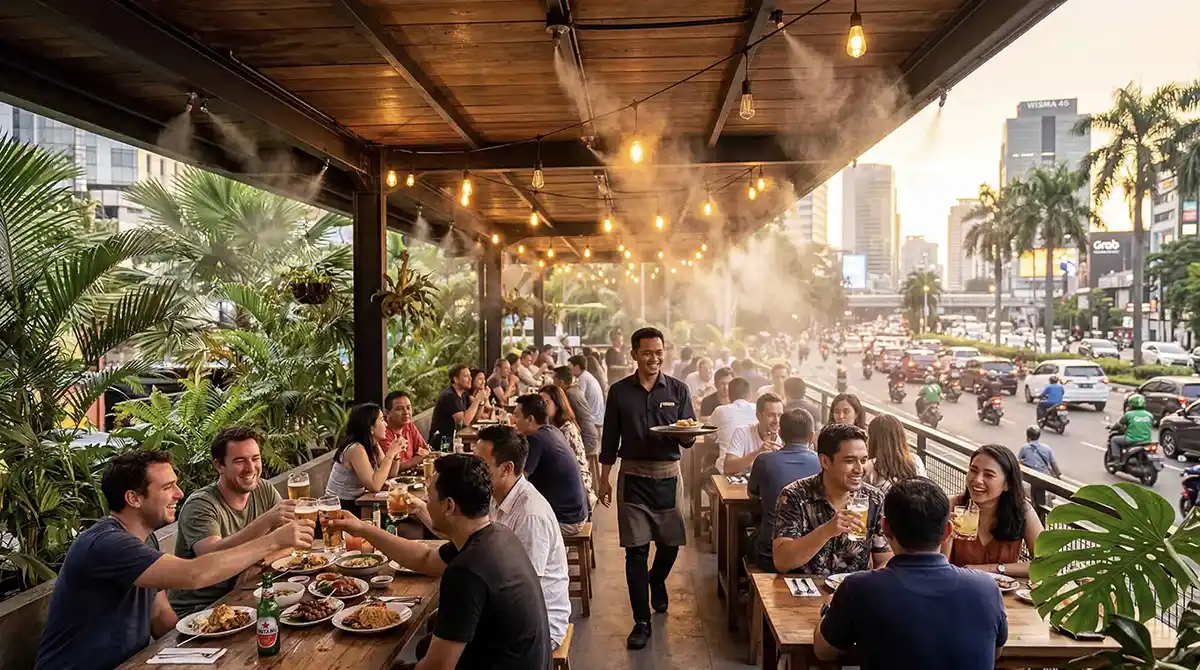
Yogyakarta’s hospitality scene is evolving fast. The city that was once primarily a cultural tourism destination — Borobudur day trips and batik shopping — now has a dining and cafe culture that stands on its own. Prawirotaman has become a full hospitality corridor. Kaliurang draws weekend crowds to hillside restaurants. And across the city, traditional joglo-style buildings are being converted into high-end dining venues that blend Javanese heritage with modern gastronomy.
What has not changed is the climate. Yogyakarta sits on a low-lying plain at just 113 meters elevation, and daytime temperatures consistently reach 32-34 degrees Celsius year-round. For a city where open-air and semi-open dining is both culturally traditional and commercially essential, heat management is a fundamental operational requirement.
The Climate Challenge in Yogyakarta
Yogyakarta’s heat profile is relentless. Unlike highland cities with cool mornings and warm afternoons, Yogyakarta starts warm and stays warm. By 10 a.m., outdoor spaces without active cooling become uncomfortable. By noon, exposed terraces are effectively unusable for dining.
Humidity compounds the problem. Average relative humidity sits between 70-85% through most of the year, which means sweat does not evaporate efficiently from skin. Guests feel hotter than the thermometer reads. A 33-degree day at 80% humidity has an apparent temperature closer to 40 degrees Celsius — well past the threshold where people choose to eat outdoors voluntarily.
The dry season (May through September) offers slightly lower humidity, but temperatures climb higher, often pushing 35 degrees. There is no comfortable season for unmanaged outdoor dining in Yogyakarta.
Where Cooling Matters: Key Hospitality Districts
Prawirotaman
Once a batik merchant neighborhood, Prawirotaman has transformed into Yogyakarta’s primary dining and nightlife strip. Guesthouses, restaurants, coffee shops, and bars line Jalan Prawirotaman I and II. Most venues feature street-facing terraces or garden courtyards. The district draws a mix of international tourists, domestic visitors, and local university students, all expecting comfortable outdoor dining in a city where indoor-only venues feel disconnected from the neighborhood’s energy.
Malioboro and City Center
The Malioboro corridor is Yogyakarta’s commercial heart. Dining options range from street food stalls to hotel rooftop restaurants. The urban density and concrete infrastructure create a heat island effect that pushes daytime temperatures 2-3 degrees above surrounding areas. Venues with rooftop or upper-floor terraces face the most extreme heat exposure, with little natural shade and full afternoon sun.
Kaliurang and Northern Slopes
The road toward Mount Merapi passes through Kaliurang, where restaurants and cafes take advantage of hillside views and slightly cooler temperatures. However, these venues depend heavily on weekend and holiday traffic, and their large outdoor dining areas — often terraced into slopes with panoramic views — need to be fully operational during peak visitor hours that coincide with peak heat.
Joglo Venues Across the City
The joglo — a traditional Javanese wooden house with a distinctive peaked roof — is increasingly being repurposed as a dining venue. The open-sided design and high ceilings were originally engineered for natural ventilation, but modern adaptations often enclose or modify the structure in ways that reduce airflow. Even well-preserved joglos with traditional open sides struggle when ambient temperatures exceed 32 degrees, because natural ventilation only works when there is a meaningful temperature differential between indoor and outdoor air.
Not sure what fits your space?
Send a photo of the area on WhatsApp — we’ll size the system and send a quote within a day. 600+ installations across Indonesia.
Heritage Architecture Meets Modern Comfort Expectations
Joglo venues face a specific tension. The architecture is the attraction — guests come for the atmosphere of dining under centuries-old teak beams surrounded by carved wooden panels. But the heritage structure limits what you can install. Visible air conditioning ducts, industrial fans, or bulky cooling equipment would undermine the aesthetic that justifies premium pricing.
This is where mist cooling has a distinct advantage. The system’s 6mm stainless steel lines and compact nozzles can be mounted along the joglo’s existing beam structure, roof edges, or pergola extensions without visual disruption. The mist itself adds atmosphere rather than detracting from it — a fine haze that evaporates instantly, complementing the traditional setting rather than clashing with it.
The Business Case for Cooling
A typical Prawirotaman restaurant with 40 outdoor seats and an average spend of Rp 80,000-150,000 per guest loses substantial revenue when heat drives guests indoors or away. If 15 outdoor covers are lost during the 11 a.m. to 3 p.m. window, that represents Rp 1.2-2.25M in daily lost revenue. Monthly: Rp 36-67M.
For joglo-style fine dining venues with higher per-guest spending (Rp 200,000-400,000), the impact per lost cover is even greater. Losing 10 outdoor seats during a four-hour peak window can cost Rp 2-4M daily.
The energy cost of running a mist cooling system — Rp 2,000-5,000 per day — is less than what most venues spend on bottled water for their staff.
System Options for Yogyakarta Venues
| Model | Coverage | Price | Best For |
|---|---|---|---|
| MistPro 100 | Up to 60 sqm | Rp 15,200,000 | Prawirotaman cafe terrace, small courtyard |
| MistPro 200 | Up to 150 sqm | Rp 16,900,000 | Joglo dining hall, mid-size garden restaurant |
| MistPro 300 | Up to 300 sqm | Rp 18,900,000 | Large joglo complex, Kaliurang hillside venue |
All systems operate at 70 bar pressure with 10-micron droplets that flash-evaporate in Yogyakarta’s warm air, dropping ambient temperature by up to 10 degrees Celsius. The result: a 33-degree terrace becomes a 23-25 degree dining experience without enclosing the space or compromising the open-air atmosphere that defines Yogyakarta’s best venues.
Every installation includes a 1-year machine warranty and uses corrosion-resistant stainless steel lines built for Indonesia’s humidity.
Why Yogyakarta Venues Are Investing Now
Yogyakarta’s tourism infrastructure is expanding rapidly. The new Yogyakarta International Airport (YIA) has increased domestic and international visitor capacity. Hotel construction is accelerating. And the dining scene is professionalizing, with more operators treating hospitality as a serious business rather than a lifestyle venture.
In this environment, the venues that capture market share are the ones that deliver a complete experience. Atmospheric architecture, quality food, and physical comfort are not separate considerations — they are all part of the same product. A beautifully restored joglo with extraordinary food that guests leave after 30 minutes because they are overheating is an incomplete product.
Mist cooling closes that gap at a fraction of the cost of enclosed air conditioning, without sacrificing the open-air character that makes Yogyakarta’s dining scene distinctive.
Get a Free Site Assessment
MistSystem has completed 600+ installations across Indonesia and understands the specific requirements of heritage and open-air venues. Contact us for a free consultation tailored to your venue’s layout and architecture.
WhatsApp: +62 851 9029 1717
Ready to cool your venue?
Chat on WhatsApp