
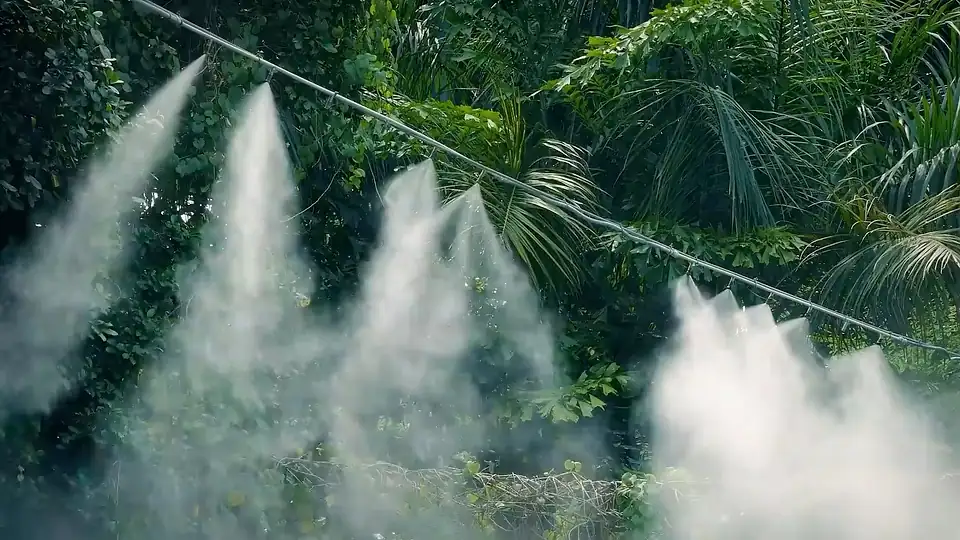
A misting system is a pump, pipework and nozzles that break water into very fine droplets and release them into the air. The purpose is cooling — and the mechanism is not what most people assume.
What it is not: spraying cold water
The most common misunderstanding. A misting system does not spray chilled water. The water is at ambient temperature.
The cooling comes from evaporation absorbing heat. When water changes from liquid to vapour it needs energy — roughly 680 Wh per litre — and it takes that energy from the surrounding air. The air loses heat and its temperature falls.
The process is adiabatic cooling: no cooling energy is added from outside, heat simply changes form from sensible heat (what a thermometer reads) into latent heat (stored in water vapour).
The direct consequence: air leaving this process is cooler and more humid. The two always travel together, and that is what limits how far the cooling can be pushed.
The components
- Pump — generates the pressure
- Water filtration — keeps nozzles from clogging
- Pipework — carries pressurised water to the nozzle points
- Nozzles — break the water into mist
- Controls — a timer, or temperature and humidity sensors
Not sure what fits your space?
Send a photo of the area on WhatsApp — we’ll size the system and send a quote within a day. 600+ installations across Indonesia.
Why pressure decides everything
For water to evaporate before landing on a surface, the droplets must be small enough. Droplet size is set by pressure.
| Pressure | Droplet size | Result |
|---|---|---|
| 3–10 bar | 50–200 microns | Lands before evaporating — wet surfaces |
| 15–40 bar | 20–50 microns | Some evaporates, some lands |
| 70+ bar | Under 10 microns | Evaporates in the air — surfaces stay dry |
The practical threshold sits around 10 microns. Below that, surface-area-to-volume ratio is high enough that evaporation is nearly instantaneous — flash evaporation.
This is the difference between “a system that leaves tables damp” and “a system that cools an area without wetting anything”. Not brand, not nozzle quality — pressure.
Where misting systems are used
Hospitality. Restaurant terraces, hotel pool decks, beach clubs, outdoor event spaces. Here “surfaces stay dry” is non-negotiable — a damp table is an empty table.
Livestock. Broiler and layer houses, particularly through the hottest hours. Beyond lowering temperature, a correctly specified system does not wet the litter — which matters because wet litter drives ammonia.
Greenhouses and agriculture. Temperature and humidity control at canopy level, plus propagation misting for seedlings and cuttings.
Industry. Humidification for textile warehouses and tobacco storage, dust suppression in material handling areas.
Residential. Home terraces, pool areas, pergolas.
What limits the result
Evaporative cooling depends on headroom for evaporation in the air. The more humid the air, the less headroom, and the smaller the temperature drop.
So the same system delivers different results in a dry climate and a humid one. In Indonesia, with high humidity year-round, the temperature drop is smaller than it would be in a desert climate.
What you still get: direct cooling in the seating zone, air movement, and a reduction in radiant load. For most outdoor areas that is the difference between usable and unused during the middle of the day.
What is not realistic: expecting an air-conditioning-like drop in an open space. The physics is different, and anyone promising that for an open area is overstating it.
Misting is not air conditioning, and is not meant to replace it
For fully enclosed spaces — hotel rooms, offices, sealed cold areas — air conditioning is the right technology. Misting is the wrong physics for an enclosed room, because humidity would climb with nowhere to go.
For open spaces the reverse holds: air conditioning barely functions because heat pours in from all around. The question is rarely “AC or misting”, it is “misting or nothing”.
What to check before buying
- Working pressure. If surfaces must stay dry, 70 bar and up. This figure matters most.
- Nozzle material. Coastal or livestock environments need 316L stainless. Brass will corrode.
- Water filtration. Determines how often nozzles clog. In hard-water areas this is not optional.
- Controls. Temperature and humidity sensors beat a timer, especially in a climate where humidity shifts through the day.
- Pump placement. High-pressure pumps are noisy — they belong well away from guests.
In short
A cooling misting system works by evaporating water, not by spraying cold water. Pressure sets droplet size, and droplet size decides whether surfaces stay dry. A 70-bar system and a 10-bar system are two different products, not an expensive and cheap version of one.
See system packages and pricing or the technical glossary. To find out whether your area is a fit, send photos, an approximate area and your city over WhatsApp. If your space does not need it, we will say so plainly.
Ready to cool your venue?
Chat on WhatsApp