
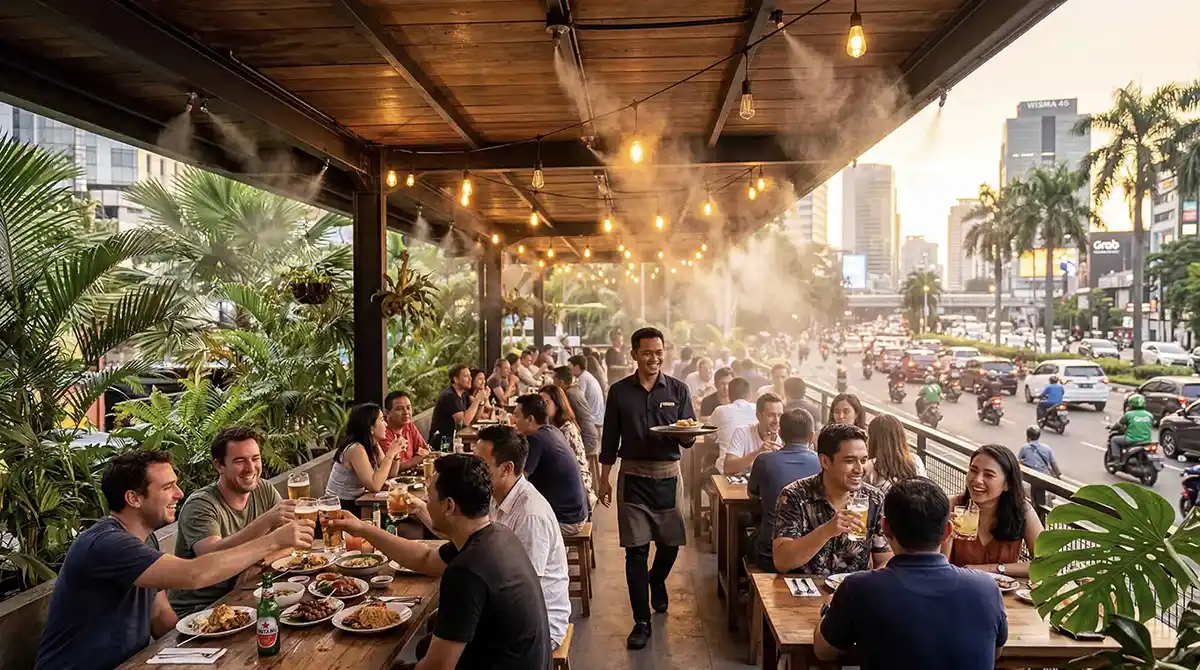
Outdoor Dining Is the Future of Indonesian Hospitality
The shift toward outdoor dining has accelerated dramatically across Indonesia. What began as a pandemic-era necessity has become a permanent consumer preference. Indonesian diners, both domestic and international, actively choose restaurants with outdoor seating, garden settings, and open-air atmosphere.
The reasons are clear:
- Atmosphere: Outdoor settings create memorable dining experiences
- Social media: Open-air venues photograph better and generate more organic social media content
- Cultural fit: Indonesia’s tropical climate and social culture align naturally with outdoor gathering
- Premium positioning: Outdoor-first venues command higher average checks
The challenge is equally clear: Indonesia is hot. With average temperatures of 30-35 degrees Celsius and humidity of 65-85% across most of the country, unmanaged outdoor dining is uncomfortable for half the day.
This guide reviews every available solution for outdoor dining comfort in tropical climates, compares their effectiveness and cost, and identifies the approach that works best.
Solution 1: Shade Structures
Types: Pergolas, shade sails, umbrellas, retractable awnings, tree canopy Temperature reduction: 3-7 degrees C (from blocking direct sun) Cost: Varies widely, IDR 5,000,000 - 100,000,000+ depending on material and scale
Pros
- Blocks direct solar radiation, the single largest heat source
- Creates visual architecture and defined dining zones
- Protects from rain in wet season
- One-time investment with long lifespan
Cons
- Does not reduce ambient air temperature
- Radiant heat from surrounding surfaces still affects comfort
- Evening hours (no direct sun) see no benefit
- Large structures may require permits
Verdict
Shade is essential but insufficient alone. It should be the foundation of any outdoor dining cooling strategy, combined with active cooling.
Not sure what fits your space?
Send a photo of the area on WhatsApp — we’ll size the system and send a quote within a day. 600+ installations across Indonesia.
Solution 2: Fans
Types: Ceiling fans, standing fans, wall-mounted fans, misting fans Temperature reduction: 0 degrees C (perceived 2-4 degrees from wind chill) Cost: IDR 500,000 - 5,000,000 per unit
Pros
- Low upfront cost
- Easy to install and relocate
- Provides immediate wind-chill sensation
- Familiar to customers
Cons
- Does not actually cool the air, only creates airflow
- In high humidity, moving hot humid air provides diminishing relief
- Noise disrupts conversation
- Blows napkins, menus, and light items
- Multiple fans increase energy cost (Rp 15,000-30,000/day)
Verdict
Fans are a low-cost starting point but hit their limits quickly in tropical heat. Effective as supplement, inadequate as primary solution.
Solution 3: Outdoor Air Conditioning
Types: Split units, portable units, evaporative coolers (swamp coolers) Temperature reduction: 1-3 degrees C in open air (theoretical capacity much higher in enclosed spaces) Cost: IDR 5,000,000 - 15,000,000 per unit, Rp 50,000-150,000/day energy
Pros
- Strong cooling in enclosed or semi-enclosed spaces
- Familiar technology with wide availability
Cons
- Fundamentally ineffective in open-air environments
- Cooled air immediately dissipates into atmosphere
- Extremely high energy consumption for minimal outdoor result
- Loud compressor noise
- Bulky equipment hurts venue aesthetics
- Uses refrigerant gases with environmental impact
Verdict
Indoor AC is excellent technology used in the wrong application. For any space without four walls and a ceiling, outdoor AC is an expensive mistake.
Solution 4: Low-Pressure Mist Systems (3-5 bar)
Types: DIY mist kits, garden mist systems, portable mist fans Temperature reduction: 2-4 degrees C Cost: IDR 500,000 - 3,000,000
Pros
- Very low upfront cost
- Easy DIY installation
- Some cooling effect
Cons
- Large droplets (50-200 microns) wet tables, food, and guests
- Unacceptable for any dining environment
- Nozzles clog frequently
- Plastic components degrade in months
- Increases humidity noticeably, creating clammy feeling
- No professional service or warranty
Verdict
Suitable for home gardens and agriculture. Completely inappropriate for commercial dining. The wet surfaces alone disqualify this option for hospitality.
Solution 5: High-Pressure Mist Cooling (70 bar)
Types: Professional systems like MistSystem with pump, stainless steel lines, precision nozzles Temperature reduction: Up to 10 degrees C Cost: IDR 15,200,000 - 26,900,000
Pros
- Largest temperature reduction of any outdoor solution
- Tables and guests stay completely dry
- Works with wind and airflow rather than against them
- Silent operation
- Minimal energy cost (Rp 2,000-5,000/day, 90% less than AC)
- Discreet installation integrates with venue architecture
- Professional-grade 6mm stainless steel construction
- 1-year machine warranty with ongoing service
Cons
- Higher upfront cost than fans or low-pressure mist
- Requires water supply and power connection
- Slightly reduced effectiveness in very high humidity (still significant)
- Professional installation required
Verdict
The most effective outdoor cooling solution available. The only option that delivers genuine temperature reduction while keeping surfaces dry. The standard for professional hospitality venues.
The Comparison Table
| Factor | Shade | Fans | Outdoor AC | Low-Pressure Mist | High-Pressure Mist |
|---|---|---|---|---|---|
| Temp drop | 3-7 C | 0 C (perceived) | 1-3 C | 2-4 C | Up to 10 C |
| Dry surfaces | Yes | Yes | Yes | No | Yes |
| Energy cost/day | 0 | Rp 15-30K | Rp 50-150K | Rp 1-3K | Rp 2-5K |
| Noise | None | High | High | Low | None |
| Dining suitable | Partial | Yes | Yes | No | Yes |
| Open-air effective | Partial | Minimal | No | Partial | Yes |
The Winning Combination
The most effective approach combines two elements:
- Shade structures to block direct solar radiation
- High-pressure mist cooling to reduce ambient air temperature
Together, shade and mist can create outdoor dining environments that feel 15-17 degrees cooler than unshaded, uncooled areas. That transforms a 35-degree exposed terrace into an 18-20 degree dining zone, which is comparable to comfortable indoor AC.
Design Considerations
When planning outdoor dining comfort, consider:
Seating orientation: Position tables away from west-facing walls that accumulate afternoon heat.
Material choices: Dark surfaces absorb and radiate more heat. Lighter colors and natural materials stay cooler.
Vegetation: Trees and plants provide natural shade and reduce perceived temperature through visual psychology.
Mist zone planning: Work with MistSystem to design cooling zones that match your seating layout and guest flow patterns.
Getting Started with MistSystem
MistSystem serves venues across Indonesia including Bali, Jakarta, Surabaya, Medan, and Makassar. With over 600 installations since 2024, we understand the specific challenges of outdoor dining in tropical climates.
Not sure whether it’s time yet? Check the signs your venue needs cooling. The process starts with a free site assessment where we evaluate your space, recommend the right system (MistPro 100, 200, or 300), and provide a detailed quote.
See what this looks like in practice at Costa Restaurant in Sanur — beachside dining made comfortable.
Design the perfect outdoor dining experience. Contact us on WhatsApp at +62 851 9029 1717.
Ready to cool your venue?
Chat on WhatsApp