
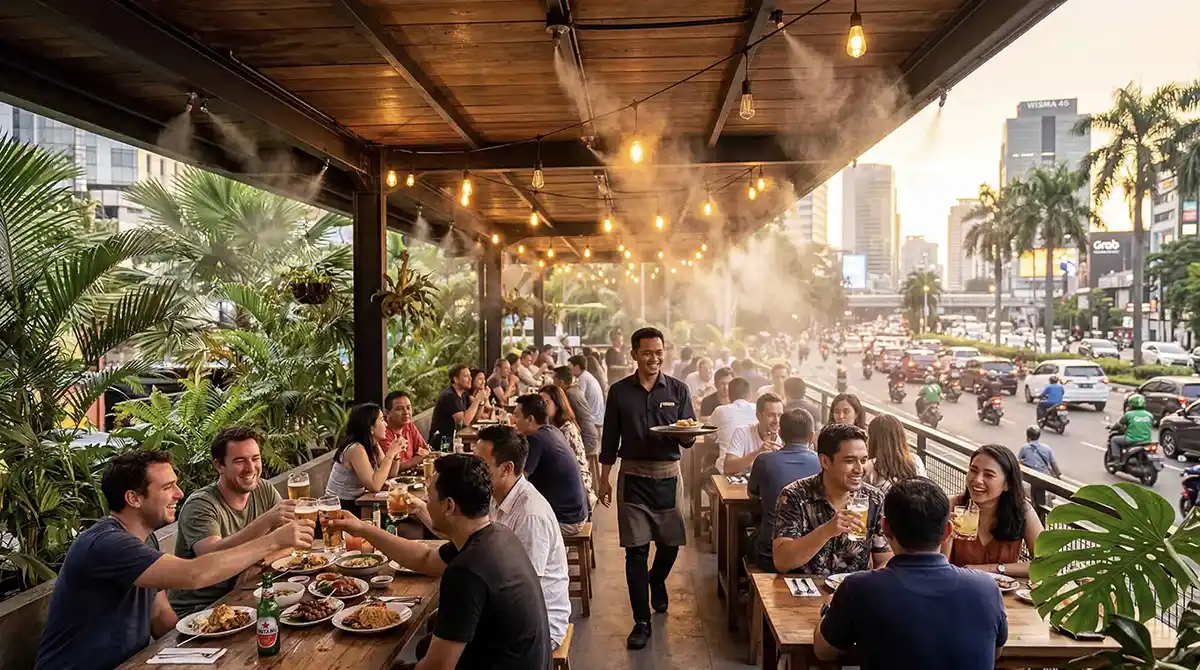
Outdoor seating is a revenue multiplier. Restaurants and cafes with well-designed terraces consistently report 30-40% higher covers during peak hours, stronger social media presence, and better walk-in conversion from street traffic. In tropical markets like Bali, Jakarta, and Southeast Asia broadly, outdoor space is not a nice-to-have — it is the primary dining environment.
But tropical climates punish bad design. Midday temperatures above 33 degrees Celsius, sudden downpours, relentless humidity, and intense UV exposure can turn an Instagram-worthy terrace into an empty liability. The difference between a packed outdoor section and an abandoned one almost always comes down to how thoughtfully the space addresses climate.
Here are 12 outdoor cafe design concepts that work in tropical conditions, each with a clear approach to the heat challenge that defines success or failure in this market.
1. The Tropical Garden Cafe
Dense planting transforms a basic patio into a lush, immersive environment. Think layered foliage — tall palms for canopy shade, mid-height heliconias and bird-of-paradise for visual walls, and ground-cover ferns for texture. Furniture in teak or rattan disappears into the greenery. Paths wind between tables, creating the feeling that each group has a private clearing.
Heat strategy: The layered canopy provides natural shade and the plants themselves cool the surrounding air through transpiration. For the hottest hours, high-pressure mist cooling lines can be threaded along the canopy structure, dropping ambient temperatures by 5-10 degrees Celsius while adding to the atmosphere rather than detracting from it. The mist evaporates before reaching table level, keeping guests and food dry.
2. Industrial Open-Air
Exposed steel, concrete floors, corrugated metal roofing, and Edison bulb strings. This concept borrows from warehouse aesthetics but leaves walls partially or fully open to tropical breezes. It works well in converted shophouses and urban lots where raw structure already exists. The key is contrast — rough industrial surfaces softened by strategic greenery and warm lighting.
Heat strategy: Metal roofing should be elevated well above the seating plane, creating a chimney effect where hot air rises and escapes through the gap between roof edge and any upper walls. Large industrial ceiling fans (1.5-meter diameter or more) mounted on the exposed beams create consistent airflow. Light-colored or reflective roofing material prevents the structure from becoming a radiant heat source.
Not sure what fits your space?
Send a photo of the area on WhatsApp — we’ll size the system and send a quote within a day. 600+ installations across Indonesia.
3. Balinese Pavilion Style
The traditional Bale Bengong — an open-sided pavilion with a thatched alang-alang roof — is one of the most climate-appropriate dining structures ever designed for the tropics. The steep roof pitch sheds rain instantly, the open sides capture cross-ventilation from any direction, and the thick thatch provides remarkable insulation against solar radiation.
Heat strategy: The design itself is the heat solution. Alang-alang roofing keeps the space significantly cooler than metal or tile alternatives. Raised floor platforms elevate guests above ground-level heat. For modern commercial applications, the traditional form is often enhanced with concealed ceiling fans and cross-ventilation channels designed into the layout orientation relative to prevailing winds.
4. Minimalist Concrete Terrace
Clean lines, poured concrete, minimal furniture, and a restrained material palette. This concept relies on architectural form — cantilevered concrete shade canopies, geometric planter boxes, and negative space — rather than decoration. It photographs well, ages gracefully in humid conditions, and requires minimal maintenance. Popular with specialty coffee concepts and design-forward restaurants.
Heat strategy: Concrete absorbs and radiates heat aggressively, so this concept demands generous overhead shade structures and careful orientation to avoid direct western sun exposure in the afternoon. Integrated water features — a shallow reflecting pool or channel along the terrace edge — provide evaporative cooling. Concrete planters with dense tropical shrubs break up radiant heat from floor surfaces.
5. Rooftop with Skyline View
Rooftop venues command premium pricing for the view alone, but the exposure that creates the view also creates a brutal microclimate. No surrounding buildings for shade, full sun exposure, and reflected heat from the roof surface below. Getting this concept right means solving a harder version of the heat problem than any ground-level design.
Heat strategy: Retractable shade sails or pergola structures with adjustable louvers let operators control coverage based on sun angle throughout the day. High-pressure mist cooling systems mounted along the pergola framework or perimeter cables are particularly effective on rooftops, where the open-air environment allows mist to flash-evaporate rapidly. Combined with overhead fans, this approach can make a fully exposed rooftop comfortable even at midday.
6. Beachfront and Poolside
Sand, water, and horizon lines create an atmosphere that no interior space can replicate. Beachfront and poolside dining concepts in Bali, Lombok, and coastal areas of Java are some of the highest-revenue outdoor formats in Indonesia. The design language is relaxed — low seating, natural materials, neutral tones that complement rather than compete with the setting.
Heat strategy: Proximity to water provides some natural cooling, but direct tropical sun on a beach terrace is still intense. Layered shade is essential — fixed timber or bamboo structures for primary coverage, with retractable canvas for flexibility. Mist cooling integrated into the shade structure perimeter adds a cooling layer without disrupting the open, breezy feel that makes beachfront dining appealing. Cross-ventilation from sea breezes should be maximized, never blocked by solid walls or screens.
7. Courtyard Dining
An enclosed courtyard — open to the sky but sheltered on all sides by building walls — creates an intimate, protected dining environment. Historically common in Mediterranean and Middle Eastern architecture, the courtyard format works exceptionally well in tropical climates when designed with climate in mind. A central tree, fountain, or garden becomes the focal point.
Heat strategy: The enclosure creates a microclimate that is more manageable than a fully exposed terrace. Shade from surrounding walls covers much of the courtyard during morning and afternoon hours. A central water feature provides passive evaporative cooling. Retractable shade canopies or tension fabric over the open top address midday sun. The enclosed space also makes fan-driven cooling more effective since air circulates within the courtyard rather than dissipating.
8. Street-Facing Terrace
The classic sidewalk cafe format — tables facing the street, a low barrier or planter separating diners from pedestrians, and an awning or canopy overhead. This is the most common outdoor dining format worldwide, and in tropical contexts, it serves double duty as both dining space and storefront marketing. Every occupied table visible from the street is a live advertisement.
Heat strategy: Deep awnings or cantilevered canopies should extend at least two meters from the building face to provide meaningful shade, not just rain protection. Motorized retractable awnings allow operators to adjust to sun position. Large oscillating fans positioned at the building wall push air outward across the seating area. Light-colored pavement or reflective surface treatments on the sidewalk reduce radiant heat bouncing up from below.
9. Multi-Level Terraced Garden
Stepping seating areas down a slope or building them up on constructed platforms creates visual drama and functional separation between dining groups. This concept is particularly suited to Bali’s hilly terrain, where many venues are built on slopes overlooking rice fields or valleys. Each terrace level becomes its own semi-private dining zone with a different vantage point.
Heat strategy: The terracing itself helps — lower levels benefit from shade cast by upper platforms during parts of the day. Dense tropical planting between levels provides additional shade and transpiration cooling. Each level can have its own shade structure tailored to its specific sun exposure. The vertical separation also improves natural airflow, as hot air rises from lower levels and draws cooler air in behind it.
10. Greenhouse and Glass House
Full or partial glass enclosures that bring the outdoors in while maintaining control over the environment. This concept creates dramatic interior spaces filled with natural light, often incorporating internal gardens and living walls. It reads as premium and photographs exceptionally well. However, without careful climate management, a glass structure in the tropics becomes an oven.
Heat strategy: This is the most technically demanding concept on this list. UV-filtering glass is non-negotiable. Motorized louvered vents at the roof peak allow hot air to escape. Internal air circulation systems, shade-providing climbing plants on the glass surfaces, and automated blinds on the sun-facing sides are all necessary. Some successful tropical glass house concepts solve the problem by leaving significant portions of the glass walls open or using perforated screens instead of solid glass on the hottest-facing sides.
11. Bamboo and Natural Materials
Full bamboo construction — from structural columns and roof trusses to furniture and decorative screens — creates an aesthetic that is unmistakably tropical and deeply tied to Indonesian building tradition. The material is sustainable, locally abundant, structurally versatile, and visually distinctive. Venues built primarily from bamboo consistently rank among the most-shared dining spaces on social media in Bali and beyond.
Heat strategy: Bamboo is a naturally cooler material than steel or concrete. It does not absorb and re-radiate heat the way metal structures do. Open-weave bamboo screens allow air to pass through while filtering direct sun. Thatched or bamboo-shingle roofing provides good insulation. The open, airy construction style typical of bamboo architecture promotes continuous natural ventilation, which is the most energy-efficient cooling method available.
12. Night Market and Festival Style
Casual, high-energy, communal. Long shared tables, string lights, open food stalls or a visible kitchen line, and a deliberate lack of formality. This concept draws from Southeast Asian night market culture and adapts it to a permanent venue format. It works well for high-volume, lower-ticket concepts and creates an atmosphere that encourages lingering and repeat visits.
Heat strategy: Evening operation sidesteps the worst of the tropical heat. For venues that also serve during daytime, tensioned fabric sails in overlapping configurations provide shade while maintaining the open, market-like feel. Large industrial fans on tall stands — the kind you see at actual outdoor markets — are both functional and aesthetically consistent with the concept. The casual format also means guests are more tolerant of imperfect climate control than they would be in a fine-dining context.
The One Thing Every Outdoor Design Needs: Climate Control
Every concept on this list addresses the heat challenge differently — through shade structures, material choices, orientation, natural ventilation, water features, or fans. The best outdoor venues layer multiple strategies together rather than relying on any single solution.
What separates a venue that is packed year-round from one that empties out between 11 a.m. and 4 p.m. is not aesthetics. It is whether guests feel physically comfortable sitting there for an hour or more. No amount of beautiful design compensates for a dining experience where guests are sweating through their meal.
For venues where natural shade and fans are not sufficient — rooftops, open terraces, beachfront decks, and any space with significant sun exposure — high-pressure mist cooling is the most effective active cooling solution for open-air environments. Systems like MistSystem use fine nozzles operating at 70+ bar to create micro-droplets that evaporate almost instantly, lowering ambient temperature by up to 10 degrees Celsius without wetting surfaces, furniture, or guests.
The technology integrates cleanly into most design concepts. Mist lines mount along existing pergolas, canopy edges, or cable runs. The nozzles are small enough to be nearly invisible. For design-driven venues where visible HVAC equipment would compromise the aesthetic, mist cooling operates silently and out of sight.
The practical impact is straightforward: a comfortable outdoor space seats more guests, keeps them longer, and operates more hours per day. In tropical hospitality markets where outdoor space is the primary revenue driver, climate control is not an add-on — it is foundational infrastructure.
Getting Started
Before committing to any design concept, spend time at the site during the hottest part of the day. Note where the sun hits, where shade falls naturally, and which direction breezes come from. These observations will determine which concept works for your specific location — and what level of active cooling you will need to make it viable year-round.
The best outdoor cafe designs do not fight the tropical climate. They work with it, using smart material choices, strategic orientation, and targeted cooling to create spaces that feel like the tropics at their best — warm, lush, and effortlessly comfortable.
Ready to cool your venue?
Chat on WhatsApp