
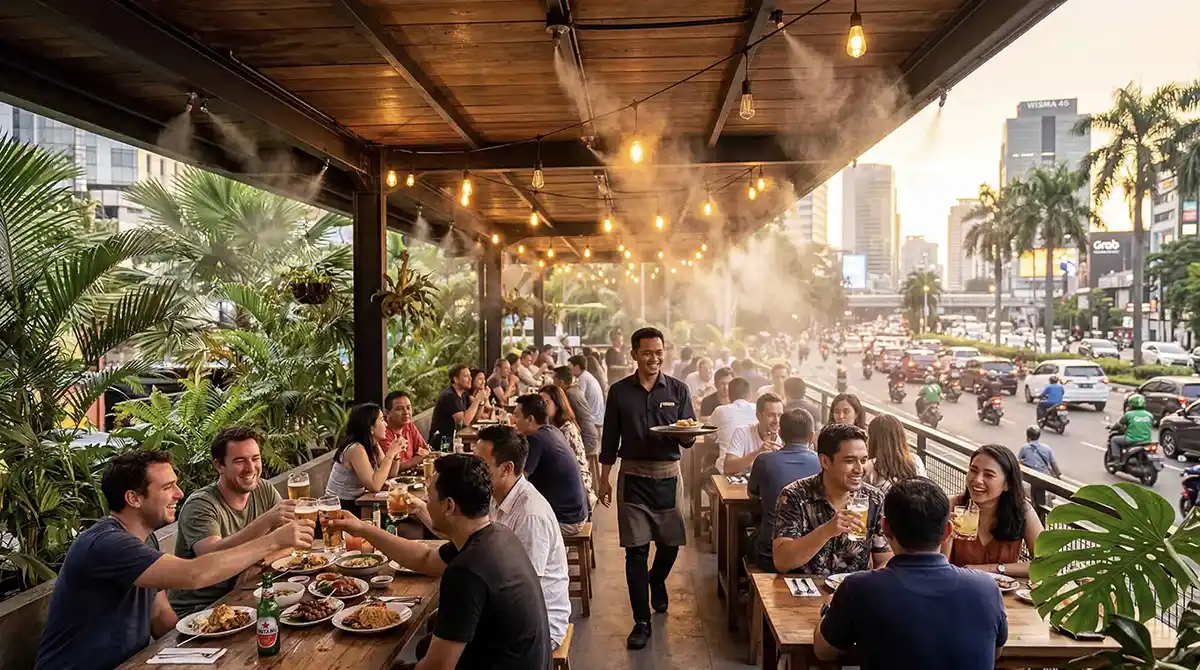
Every dry season the same request comes up: the venue is hot, the event is already scheduled, and a misting fan rental vendor can deliver today. Renting feels safe — no commitment, no installation.
For some cases that’s exactly right. For others, renting turns into a subscription you pay again every year without ever ending up with an asset. Here’s how to tell the difference.
When renting is the right answer
One-off events. An outdoor wedding, a company gathering, a weekend bazaar. You need cooling for a few hours at a location you don’t own — rent, use, return. There is no scenario where buying or installing anything makes more sense.
Temporary locations. A pop-up store, a seasonal bazaar stall, a venue whose lease has months left on it. Don’t invest in property you’re about to leave.
Genuine occasional peaks. Your venue is comfortable ten months a year and only struggles at the peak of dry season during major events. Rental covers the spike without fixed costs.
The pattern: renting solves temporary problems. The strengths and limits of misting fans as a tool are covered in our mist fan vs misting system comparison.
When renting becomes a trap
The problem isn’t renting itself — it’s renting repeatedly for a problem that’s permanent.
Indonesia’s dry season is not a surprise: it arrives every year and lasts for months. If your terrace is hot every midday from May to October, that’s not an “occasional peak” — it’s a permanent operating condition of your venue.
The calculation is simple enough to run yourself:
- How many units does it take to cover the whole guest area? (A misting fan’s effective radius is 2–4 metres — a 60 m² terrace needs 5–8 units.)
- How many days per season do you actually rent?
- Multiply: units × your vendor’s daily rate × days × the number of seasons ahead.
Compare that number against installed system packages starting at Rp 15.2 million — paid once, with daily electricity costs of roughly Rp 2,000–5,000 and a one-year machine warranty. For venues renting for months every year, break-even usually arrives well before the second dry season ends.
Not sure what fits your space?
Send a photo of the area on WhatsApp — we’ll size the system and send a quote within a day. 600+ installations across Indonesia.
The differences that don’t fit in a calculator
Cost isn’t the only gap. A rented fan is still a misting fan, with everything that implies:
- Damp tables near each unit — 50–200 micron droplets land before they can evaporate.
- Cables and tanks in the guest area, managed by your staff at peak hour.
- Fan-blade noise in every zone.
- It comes and goes. Every season: order again, position again, train staff again.
An installed system works the other way around: the nozzle line hides in the structure, nothing needs refilling or repositioning, surfaces stay dry, and the temperature drop reaches 10°C — the mechanism is explained in how mist cooling works.
Two sensible middle paths
Two combinations we regularly see work:
Rent first, install later. Rent for your first season — and record how many days you actually used it and what guests said. That data turns the installation decision into arithmetic instead of a guess.
Install for the core zone, rent for big events. The installed system covers the main seating area all season; for the annual event that spills into the car park or garden, add rented fans for those few days only.
The short version
Rent misting fans for events, temporary locations, and genuinely occasional peaks. For heat that returns every dry season at a venue you plan to occupy for years, add up several seasons of rental — it’s almost always the price of a system you could own.
Want the exact numbers for your venue? Send a photo of the area, its approximate size, and your city via WhatsApp — we survey within 48 hours and give you an honest rent-vs-install comparison for your case.
Ready to cool your venue?
Chat on WhatsApp