
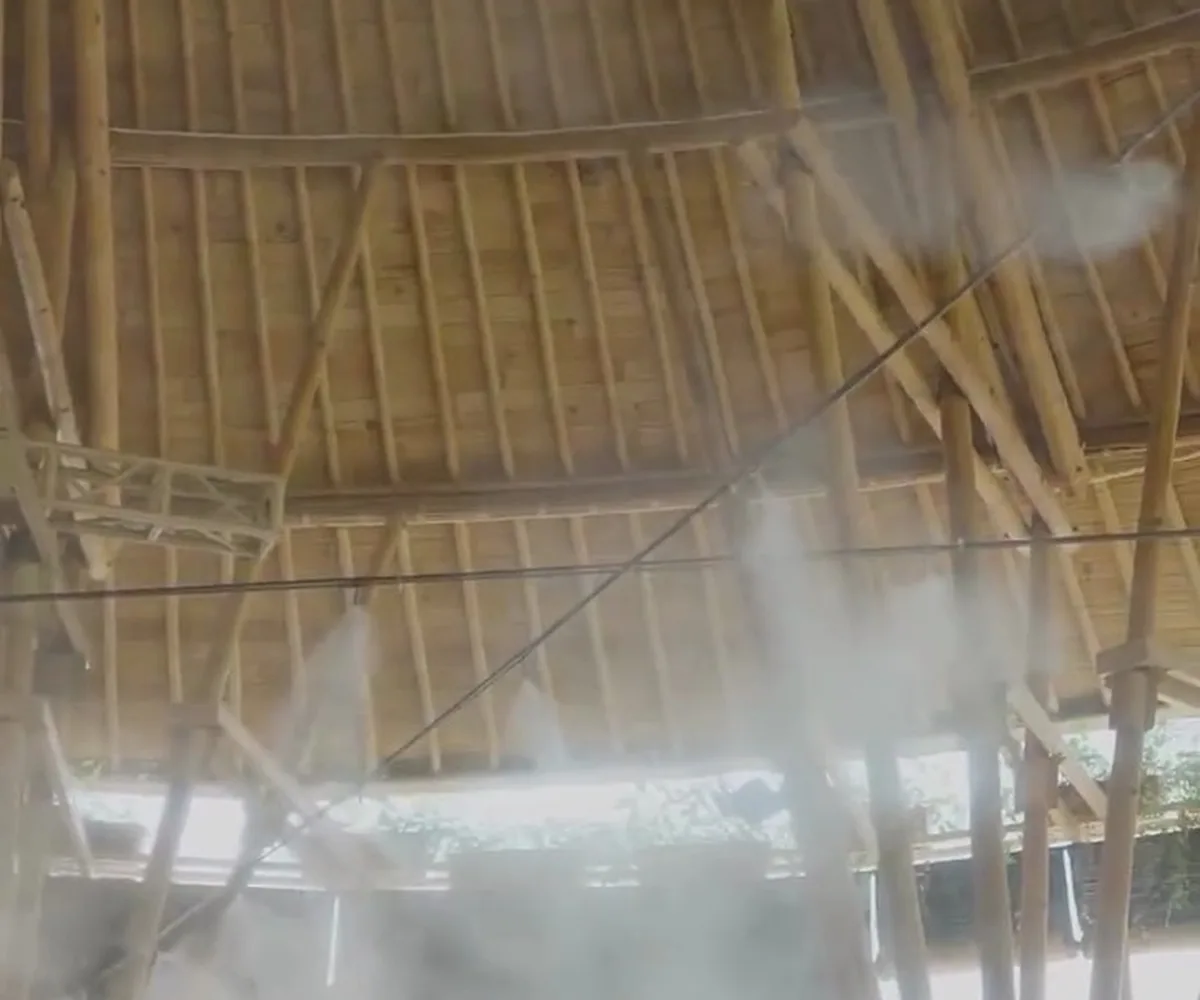
Most of the world’s misting equipment is designed for Arizona, Dubai, or southern Europe — dry-air markets where even mediocre mist evaporates. Southeast Asia is a different physics problem: 70–90% relative humidity, daily tropical downpours, intense UV, and venues where a single wet table costs a repeat customer.
This is a buyer’s guide for that reality — for venue owners in Indonesia, Singapore, Kuala Lumpur, Bangkok, or anywhere the air is already half-full of water.
The one spec that decides everything: pressure
In humid air, the margin for error disappears. Droplets must evaporate before they land, and that is determined almost entirely by droplet size, which is determined by pump pressure:
| Pressure class | Droplet size | In tropical humidity |
|---|---|---|
| Low (3–10 bar) | 50–200 microns | Lands on surfaces — wet tables, damp guests |
| Mid (“fog”, 15–30 bar) | 20–50 microns | Marginal in dry climates, wet furniture here |
| High (70+ bar) | Under 10 microns | Evaporates mid-air; surfaces stay dry |
A system that works in Phoenix at 30 bar will disappoint in Jakarta. The full physics of why sub-10-micron droplets still evaporate at 80% humidity is in does mist cooling work in humid climates.
Four regional realities your system must survive
1. Humidity needs zone design, not a hose of fog. With less evaporation headroom per cubic metre of air, coverage has to be engineered per zone, with airflow keeping near-saturated air moving out of the misted area.
2. Tropical water clogs nozzles. High mineral content and sediment are common across the region. Without proper filtration, nozzle orifices — thinner than a hair — clog within weeks. Filtration is not an accessory; it’s a system requirement. (Maintenance cadence: misting system maintenance guide.)
3. Outdoor hardware corrodes fast here. Salt air near coasts, constant humidity, UV. Stainless steel lines and nozzles (316L grade) are the difference between a system that lasts and one that streaks rust down your walls. See what 316L stainless means.
4. The rainy season exists. The system idles for weeks at a time; stagnant water and mineral deposits are the enemies. A tropical-spec system comes with a wet-season routine — ours is documented in the rainy season guide.
Not sure what fits your space?
Send a photo of the area on WhatsApp — we’ll size the system and send a quote within a day. 600+ installations across Indonesia.
Questions that expose an unsuitable supplier
Ask any vendor these five questions before signing:
- “What pressure does the pump run at, and what droplet size results?” No number, or under 70 bar — walk away for a guest-area installation.
- “How many installations do you have in this climate?” Imported dry-climate brands often have zero regional references.
- “What filtration ships with the system, and what’s the nozzle-cleaning interval with local water?” Honest answer: cleaning every 2–4 weeks depending on water quality.
- “What are the lines and nozzles made of?” Anything but stainless steel corrodes visibly within a couple of tropical seasons.
- “What happens during the rainy months?” A supplier without a wet-season answer hasn’t operated here.
What it costs in this region
For reference against imported quotes: our Indonesian installations run on machine packages from Rp 15.2 to 26.9 million depending on area, with daily electricity around Rp 2,000–5,000 and water use of 2–8 litres per minute while active. Full breakdown: what mist cooling costs and the pricing page.
The short version
In Southeast Asia, misting is not a commodity purchase — it’s a spec sheet problem. 70 bar and sub-10-micron droplets are the entry ticket; filtration, stainless hardware and a wet-season routine are what keep the system alive. Any supplier who can’t answer the five questions above is selling you dry-climate equipment in the wrong hemisphere.
Running a venue in the region? Send a photo, the area size, and your city via WhatsApp — we’ll tell you honestly what a tropical-spec system looks like for your space.
Ready to cool your venue?
Chat on WhatsApp