
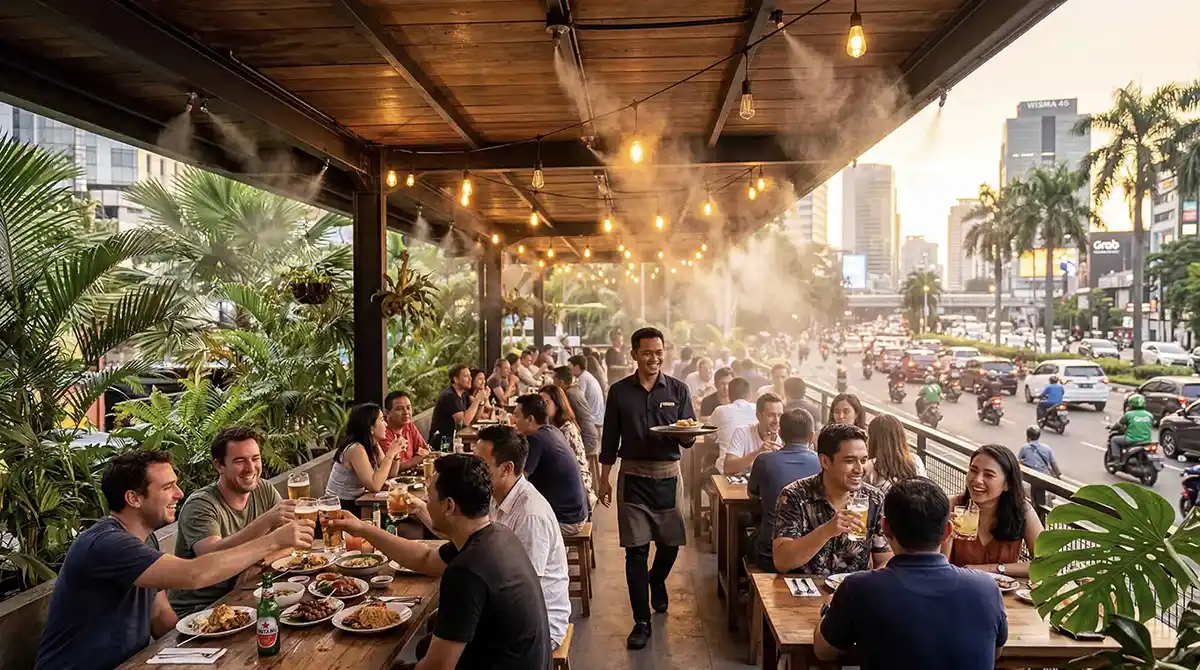
Indonesia’s food and beverage market is projected to reach USD 70 billion in 2026, growing at nearly 13% annually. The country’s rising middle class, booming tourism sector, and deep cultural connection to dining out make it one of the most compelling F&B markets in Southeast Asia.
But between permits, location decisions, and operational setup, the path from idea to opening day has more steps than most people expect. This guide walks you through each one, based on what actually works on the ground in 2026.
1. Define Your Concept and Target Market
Before you sign a lease or register a company, get clear on what you are building and who you are building it for.
Indonesia’s restaurant landscape spans everything from casual warungs to high-end beach clubs. The segment you choose determines your capital requirements, licensing complexity, and location strategy.
Key concept categories:
- Casual dining — the largest segment, representing over 50% of Indonesia’s foodservice market. Lower barriers to entry, higher volume required.
- Fine dining — smaller market, but strong margins. Works best in Jakarta, Bali, and Surabaya where spending power supports premium pricing.
- Cafe or coffee bar — the fastest-growing segment in Indonesia, with specialty coffee chains scaling rapidly. Lower startup costs, but intense competition.
- Bar or lounge — viable in tourist areas, but requires alcohol licensing (covered in Step 4).
- Beach club or destination venue — high capital requirements, but Bali’s tourism traffic supports premium concepts.
Define your target customer early. Are you serving local Indonesian families, expat professionals, tourists, or a mix? This decision shapes everything from menu pricing to interior design to marketing channels.
2. Choose Your Location
Location will make or break your restaurant. Indonesia’s geography and market dynamics mean that the right city, neighborhood, and even the right side of the street matter enormously.
Bali vs. Jakarta vs. Emerging Cities
Bali attracts the most attention from foreign investors. Tourist foot traffic is concentrated in Seminyak, Canggu, Ubud, and the Nusa Dua corridor. Commercial leases in prime Bali areas typically run 2 to 7 years, with upfront payments common. Expect to pay significantly more per square meter in Canggu or Seminyak compared to areas like Tabanan or Sanur.
Jakarta is where the volume is. With over 11 million residents and a massive daily commuter population, Jakarta rewards concepts that serve the local market. Rents in CBD areas are higher, but secondary locations in South Jakarta or Kemang offer better value for restaurant concepts.
Emerging cities like Surabaya, Bandung, Yogyakarta, and Makassar offer lower operating costs and less competition. If your concept does not depend on tourist traffic, these markets deserve serious consideration.
What to Evaluate
- Foot traffic vs. destination dining. High-traffic locations cost more but reduce your marketing burden. Destination venues need a reason for people to seek you out.
- Lease structure. In Bali, multi-year prepaid leases are standard. In Jakarta, monthly rent is more common. Negotiate renewal terms upfront.
- Parking and access. This matters more than most newcomers expect. Indonesians drive, and limited parking will cost you customers.
- Zoning. Confirm the location is zoned for commercial F&B use before you commit. This is especially important in residential areas of Bali.
Not sure what fits your space?
Send a photo of the area on WhatsApp — we’ll size the system and send a quote within a day. 600+ installations across Indonesia.
3. Set Up Your Legal Structure
Your legal structure depends on whether you are Indonesian or foreign.
For Indonesian Citizens
Register a PT (Perseroan Terbatas) — a standard limited liability company. Minimum authorized capital is IDR 50 million, and you can register through the OSS (Online Single Submission) system. The process is straightforward and typically takes 2 to 4 weeks.
For Foreign Investors
You will need a PT PMA (Penanaman Modal Asing) — a foreign-owned limited liability company. As of 2026, the requirements are:
- Total investment plan: minimum IDR 10 billion (approximately USD 600,000), applied per city or regency, not per outlet.
- Paid-up capital: minimum IDR 2.5 billion (approximately USD 150,000), which must remain in the company account for at least 12 months.
- Foreign ownership: 100% foreign ownership is permitted for many F&B and tourism-related activities under the current Positive Investment List.
The IDR 10 billion investment threshold is the total project value, including leasehold, renovation, equipment, and working capital — not just cash in the bank. Work with a licensed legal consultant or notary to structure this correctly from the start.
4. Obtain Licenses and Permits
Indonesia’s licensing system has been consolidated through the OSS (Online Single Submission) platform, but the restaurant sector still requires several layers of approval.
Essential Permits
- NIB (Nomor Induk Berusaha) — your primary business identification number, obtained through OSS. This is the foundation for all other permits.
- Commercial Operating License (Izin Operasional) — sector-specific authorization to operate a food and beverage business.
- TDUP (Tanda Daftar Usaha Pariwisata) — a tourism business registration required for restaurants in tourism zones, particularly in Bali.
- Location Permit and Building Use Certificate (PBG) — confirms your venue meets zoning and building safety requirements.
- Environmental Document (SPPL or UKL-UPL) — environmental compliance documentation, scaled to your business size and risk level.
- Halal Certification — mandatory for F&B businesses under Indonesia’s Halal Product Assurance law, with phased enforcement through 2026.
Alcohol Licensing
If you plan to serve alcohol, you will need an SIUP-MB (or its OSS equivalent, the SKPL Minol), which authorizes on-site alcohol sales. Licenses are classified by alcohol content:
- Class A: beer and low-alcohol beverages (up to 5% ABV)
- Class B: wine and fermented drinks (5-20% ABV)
- Class C: spirits and hard liquor (above 20% ABV)
You will also need a SITU-MB — a venue-specific permit confirming your location meets local safety and zoning standards for alcohol service. Budget for a 10% regional tax (PBJT) on all alcohol sales, plus 11-12% VAT depending on your turnover status.
Alcohol licensing adds cost and complexity. If your concept does not require it, you simplify your regulatory burden significantly.
5. Design and Renovate Your Space
Hire a local architect and contractor who have experience with restaurant buildouts in your area. Building codes, material availability, and construction timelines vary significantly between Bali and Jakarta.
Key Considerations
- Indoor and outdoor zones. In Indonesia’s climate, outdoor seating is not optional — it is expected. Plan your floor plan to maximize covered outdoor space with proper drainage and ventilation.
- Kitchen workflow. Design your kitchen for the menu you plan to serve. Retrofitting a kitchen layout after opening is expensive and disruptive.
- Compliance. Your buildout must meet fire safety, sanitation, and accessibility requirements for your PBG (building use certificate).
- Timeline. Renovation in Bali typically takes 3 to 6 months for a mid-sized restaurant. In Jakarta, permitting can add additional time. Build buffer into your schedule.
Budget 30-40% of your total startup capital for design and renovation. Cutting corners here creates problems that are expensive to fix later.
6. Source Equipment and Infrastructure
Your equipment list depends on your concept, but every restaurant in Indonesia needs to plan for the same core categories.
Kitchen and Bar
Commercial kitchen equipment, refrigeration, exhaust systems, and dishwashing. Source locally where possible — import duties and shipping timelines add cost. Jakarta has more established commercial kitchen suppliers, but Bali’s market has grown significantly.
Front of House
POS system (several Indonesia-specific platforms like Moka and iSeller integrate with local payment methods and tax reporting), furniture, lighting, and tableware. Invest in durable outdoor furniture — the climate is hard on cheap materials.
Climate Control
If your venue has outdoor seating — and in Indonesia, it should — plan for climate control from the start. High-pressure mist cooling systems are now standard equipment for terraces in Bali and Jakarta, keeping outdoor areas comfortable even during peak heat hours. A properly designed misting system can reduce ambient temperature by 8-12 degrees Celsius, which directly impacts how long guests stay and how much they spend. Factor this into your infrastructure budget alongside ventilation and ceiling fans.
Utilities and Backup
Reliable power is not guaranteed everywhere. Budget for a generator or UPS for your kitchen and POS system. Water quality varies — install appropriate filtration for both kitchen and bar use.
7. Hire and Train Your Staff
Finding and retaining good staff is one of the biggest operational challenges in Indonesia’s restaurant industry.
Salary Benchmarks (2026)
Minimum wages vary significantly by region:
- Jakarta: IDR 5,729,876 per month
- Bali (Badung regency): IDR 3,791,003 per month
- Bali (Denpasar): IDR 3,499,879 per month
- Lombok (NTB province): IDR 2,673,861 per month
These are minimums for employees with less than one year of service. Experienced kitchen staff, floor managers, and bartenders command significantly more. For hospitality and catering roles in Bali’s tourist areas, the sectoral minimum is approximately IDR 3.8 million for 4 and 5-star classified venues.
Hiring Realities
- Bali has a large hospitality talent pool thanks to tourism, but competition for experienced staff is intense, especially in peak season.
- Jakarta offers deeper labor markets, but restaurant workers often have long commutes that affect reliability.
- Training investment is not optional. Build 2 to 4 weeks of pre-opening training into your timeline and budget. Indonesian labor law requires providing training and development opportunities.
Plan for staff meals, transportation support, and BPJS (national health and employment insurance) contributions, which are mandatory.
8. Develop Your Menu and Supplier Relationships
Your menu is your product. Develop it in parallel with your kitchen design, not after.
Menu Strategy
- Price your menu based on local purchasing power, not just food cost percentages. A dish that works at IDR 180,000 in Seminyak may need to be IDR 65,000 in Surabaya.
- Source locally first. Indonesian produce, seafood, and proteins are abundant and high quality. Imported ingredients add cost, complexity, and supply chain risk.
- Plan for seasonal availability. Some ingredients have significant price swings during Ramadan, holiday periods, and rainy season.
Building Supplier Relationships
Visit local markets (pasar) and establish direct relationships with producers where possible. For larger operations, work with established distributors who can provide consistent quality and invoicing. Negotiate payment terms — most suppliers in Indonesia operate on 7 to 14-day payment cycles.
9. Plan Your Pre-Launch Marketing
You do not need a massive budget to launch effectively, but you do need to start early.
3 to 4 Months Before Opening
- Build your Instagram presence. Indonesia has over 100 million Instagram users, and it remains the primary discovery platform for restaurants. Post construction progress, menu development, and behind-the-scenes content.
- Create a Google Business Profile with your location, hours, and initial photos. This takes time to index and start generating local search visibility.
4 to 6 Weeks Before Opening
- Host a soft opening for friends, family, and local community. Use it to stress-test your kitchen, service flow, and POS system.
- Invite local food bloggers and content creators. In Bali and Jakarta, micro-influencers with 10,000 to 50,000 followers often deliver better ROI than large accounts. Offer a complimentary dinner in exchange for honest coverage.
2 Weeks Before Opening
- Announce your opening date across all channels with a clear call to action — reservation link, WhatsApp number, or walk-in policy.
- List on delivery platforms (GoFood, GrabFood, ShopeeFood) if delivery is part of your model. These platforms drive significant volume in Jakarta especially.
10. Opening Day and the First 90 Days
Your restaurant is not truly open on day one. The first 90 days are an extended launch where you refine everything.
Common Mistakes to Avoid
- Overstaffing or understaffing. Start lean, then adjust based on actual traffic patterns.
- Ignoring cash flow. Revenue ramps slowly. Most restaurants do not hit consistent revenue until month 3 or 4. Have at least 6 months of operating expenses in reserve.
- Neglecting online reviews. Your first 20 Google reviews set the tone. Actively encourage satisfied guests to leave feedback.
- Changing the menu too quickly. Give dishes at least 4 to 6 weeks before you cut them. Early data is noisy.
What to Track
- Daily covers and average check size. These are your two most important numbers.
- Food cost percentage. Target 28-35% depending on your concept.
- Staff-to-guest ratio during different shifts and days of the week.
- Online engagement and review sentiment. Respond to every review, positive or negative.
The restaurants that survive their first year in Indonesia are the ones that treat the first 90 days as a learning period, not a victory lap. Stay close to the operation, listen to your staff and customers, and adjust methodically.
Opening a restaurant in Indonesia is not simple, but it is achievable with the right preparation. The market is large, growing, and full of opportunity for operators who do the work upfront. Take each step seriously, get your legal and financial foundations right, and build a team that shares your vision. The rest is execution.
Ready to cool your venue?
Chat on WhatsApp