
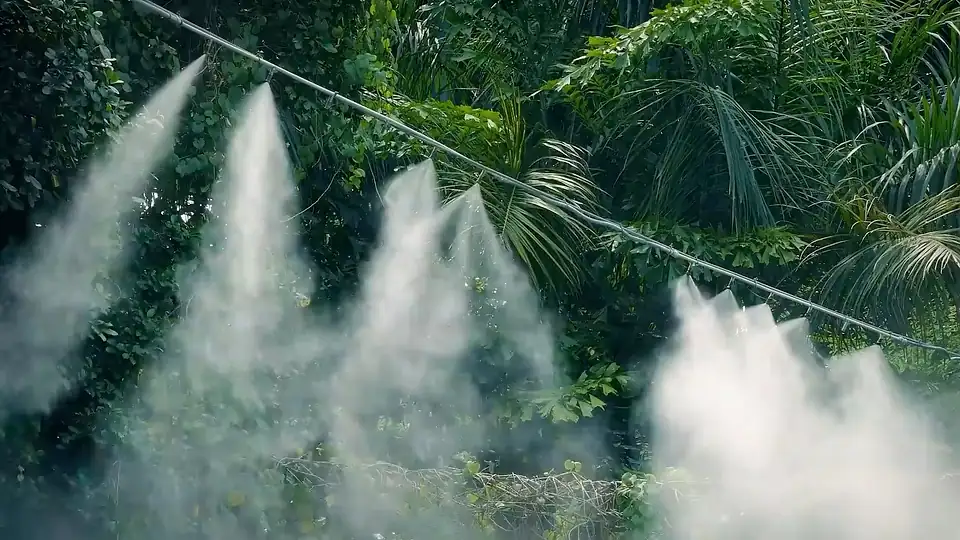
A greenhouse in a tropical climate faces the opposite problem from one in a temperate climate. In Europe, greenhouses are built to retain heat. In Indonesia, a greenhouse traps heat the crop does not want.
Same structure, opposite purpose — and that changes the equipment required.
What misting controls in a greenhouse
A high-pressure misting system performs three distinct jobs, often all at once:
Temperature reduction. Evaporation draws heat out of the canopy air. This is what is most needed between 11:00 and 15:00.
Humidity maintenance. Many high-value tropical crops — orchids, anthurium, ornamentals — grow best at humidity above what hot, ventilated greenhouse air provides.
Propagation misting. Unrooted seedlings and cuttings cannot draw water through roots. They survive on humidity around the leaf. Fine, frequent misting keeps the leaf surface from losing water faster than it can be replaced.
That third job has different technical requirements from the first two, and is normally separated into its own zone.
Why droplet size matters more here
In a hospitality venue, large droplets mean damp tables — annoying but not damaging. In a greenhouse the consequences are more serious.
Droplets of 50 microns and up (low-pressure fogging, 3–15 bar):
- Land on leaves and persist as a film of water
- Standing water on leaf surfaces is ideal for fungal and bacterial disease
- Floors stay wet all day, encouraging moss and algae
- On sensitive crops, water droplets under direct sun can cause leaf marking
Droplets under 10 microns (high pressure, 70 bar):
- Evaporate in the canopy air before landing
- Leaves, floors and equipment stay dry
- Cooling happens in the air, not on surfaces
The difference is not about comfort as it is in a restaurant. In a commercial greenhouse it is about disease risk and lost crop.
Planning cooling for your farm?
Send a photo or video of the barn on WhatsApp — we’ll size the system for your headcount and send a quote within a day.
Humidity has an upper limit too
Raising humidity is the goal — up to a point.
Excessively high humidity sustained over time creates its own problems:
- Plant transpiration slows, which impairs nutrient uptake from the roots
- Fungal risk rises
- Condensation forms on cool surfaces overnight
Which makes sensor-based control not an accessory. A system on a fixed timer keeps running on overcast, humid days, pushing humidity into the risk zone.
Correct control reads temperature and humidity, and stops when either hits its threshold.
Zoning: why one setting is not enough
Commercial greenhouses rarely grow one thing under one set of conditions.
- Propagation areas need high humidity and frequent short misting cycles
- Growing-on areas need temperature control at moderate humidity
- Hardening-off areas are deliberately kept drier to prepare plants for transplant
Running all three from one line on one setting means compromising two of them. A multi-zone system with a solenoid valve per zone resolves it.
Zoning also saves: only the section that needs it runs, so water and power use drop and pump duty falls.
Water quality is more critical than in other applications
Two reasons.
Nozzles. A 0.1–0.3 mm orifice clogs with mineral scale. This applies to every misting application.
Plants. Water with high mineral content leaves residue on leaves as it evaporates. On ornamentals, where the value is in appearance, mineral spotting on foliage is a direct loss.
So greenhouses often need better water treatment than hospitality applications — reverse osmosis or softening, depending on the local source.
What to check before installing
- Working pressure — 70 bar to keep foliage dry
- Nozzle material — stainless for a continuously humid environment
- Anti-drip — prevents drips pooling at low points after shutdown
- Sensor control on temperature and humidity, not a timer
- Zone division matched to crop stages
- Water treatment matched to source hardness
- Integration with existing ventilation and shading — misting works alongside both, not instead of them
In short
Greenhouse misting controls three things: temperature, humidity and propagation conditions. Droplet size decides whether the system helps or invites disease. And because humidity has an upper limit, sensor control is part of the system rather than an add-on.
For a zone and nozzle calculation for your greenhouse, send the area, crop, target temperature and humidity, and details of your water source over WhatsApp. See also our greenhouse cooling solutions.
Ready to cool your venue?
Chat on WhatsApp