
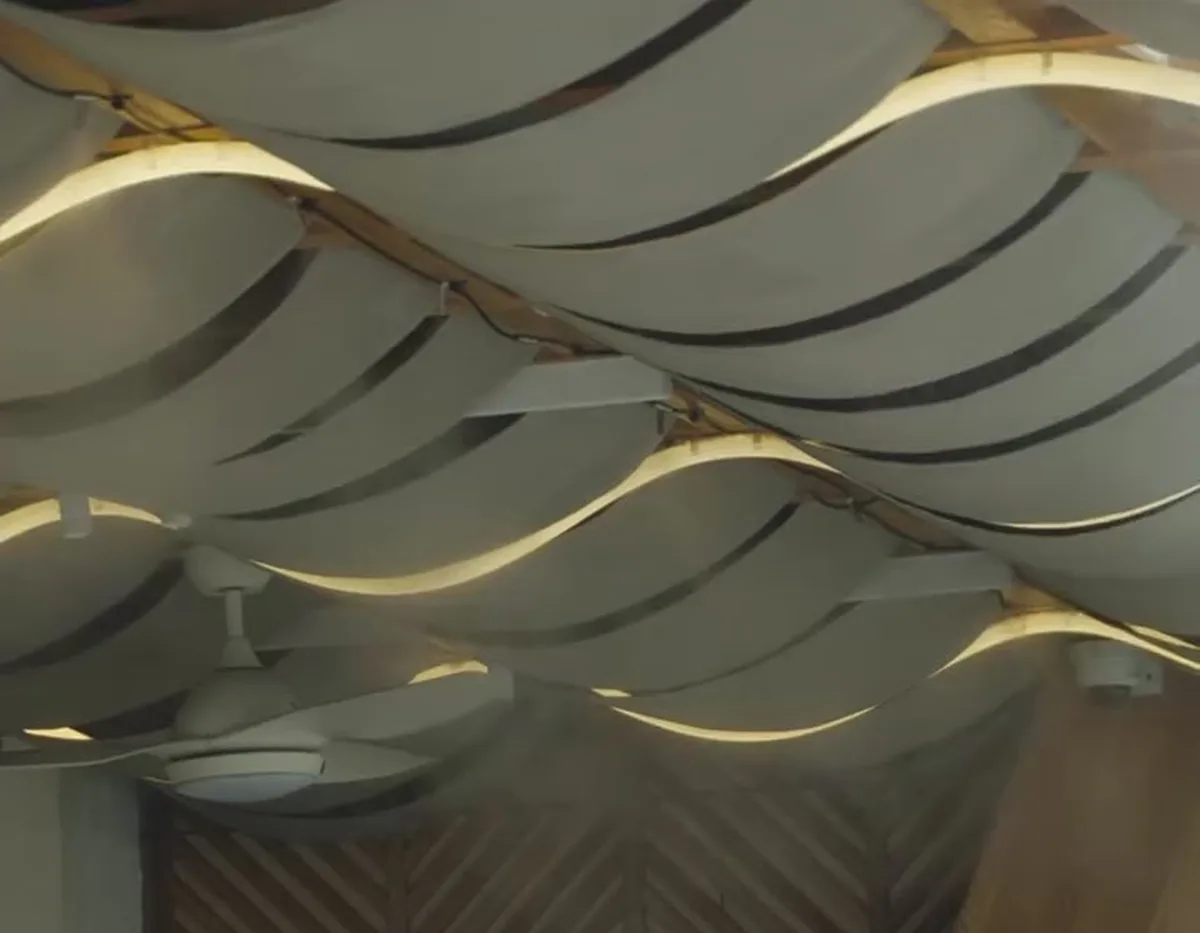
A pergola already does half the job of outdoor comfort: it takes the direct sun off your seating. What it can’t do is lower the air temperature — at 33°C, shade alone still leaves the space too hot to use at midday.
It happens that a pergola is also the ideal mounting structure for the other half of the job. This is a design guide to integrating a misting line into pergola architecture — for villa owners, and for the designers and architects who draw them.
Why pergolas and misting fit each other
A high-pressure misting system is, physically, a slim stainless line with nozzles every stretch of its run, fed by a pump that lives out of sight. It needs exactly what a pergola offers: an overhead structure at the right height above the seating zone.
Mounted along beams or the inner perimeter, the line disappears into the shadow lines of the structure. Guests see mist appearing from nowhere — not equipment. The pump sits remotely (a store room, a service corner), so the seating area gains zero visible machinery and zero noise. That invisibility is the difference between a design feature and a gadget strapped to your architecture.
Getting it right at design stage
If the pergola is still on the drawing board, three decisions make the integration seamless:
Route the services early. The line needs a water feed and the pump needs power. A conduit planned inside a column costs nothing at build time; surface-mounted pipe added later is what makes retrofits look like retrofits.
Mind the mounting height. Sub-10-micron droplets evaporate in the air below the line — the mounting height and nozzle spacing are calculated from it so evaporation completes above head level. This is the calculation our site survey does; a designer just needs to leave the beam line free.
Choose materials once. The visible hardware is 316L stainless — it belongs next to hardwood and stone and won’t streak rust down either. What that grade survives: 316L stainless explained.
Thinking about mist for your home?
Send a photo of the terrace or garden on WhatsApp — we’ll size the system and send a quote within a day.
Retrofitting an existing pergola
Most of our villa installs are retrofits, and a pergola makes them clean: the structure already provides the mounting line, so the work is routing the feed discreetly. What determines the outcome is the same physics as everywhere else — 70-bar pressure so the furniture and decking below stay dry. Anything low-pressure will drip off the beams; the difference is covered in low-pressure vs high-pressure mist.
What it does for the space
The pergola zone drops by up to 10°C when the system runs — pool decks and dining pergolas covered in detail in villa and pool area cooling in Bali. Surfaces stay dry, which matters more under a pergola than anywhere: cushions, daybeds and timber all live there.
For the broader decision — whether misting is the right tool for your villa at all, versus fans or shade alone — start with the villa outdoor cooling decision guide.
The short version
A pergola is the one structure where misting can be genuinely invisible: line along the beams, pump out of sight, services routed inside the build. Plan it at drawing stage if you can; retrofit it cleanly if you can’t. Either way the calculation that keeps everything dry is done per structure — send photos of your pergola and its dimensions via WhatsApp, and we’ll design the line around your architecture, not on top of it.
Designers and architects: the partner program pays a commission when you spec us into a project.
Ready to cool your venue?
Chat on WhatsApp