
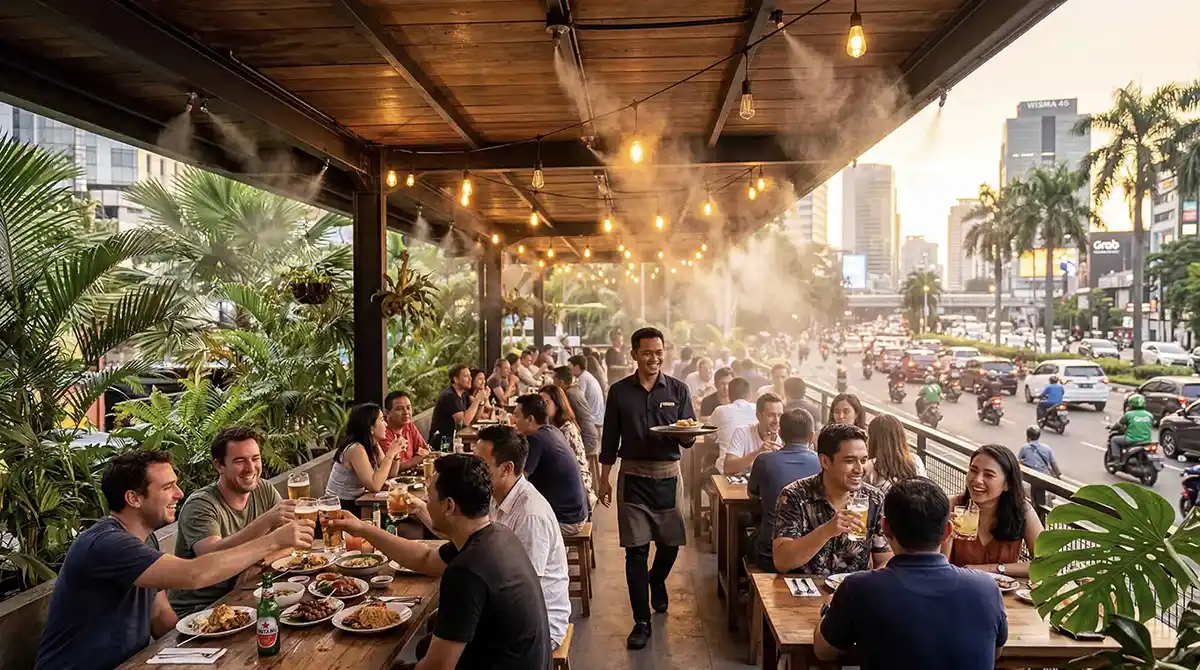
Outdoor seating is one of the most valuable assets a restaurant can have. In Bali, Jakarta, and across Indonesia, guests prefer open-air dining. But the tropical heat creates a problem that directly hits your revenue. This guide covers everything you need to know about keeping your outdoor space cool, comfortable, and profitable.
Why Outdoor Seating Equals Revenue
Outdoor terraces are not just an aesthetic choice. They are a revenue multiplier.
Venues with comfortable outdoor seating consistently report higher average spend per guest. People linger longer when they are comfortable. They order another round of drinks. They stay for dessert. They take photos and share them online, generating free marketing for your venue.
In tourist-heavy areas like Seminyak, Canggu, Ubud, and Nusa Dua, an attractive outdoor space can be the difference between a fully booked evening and empty tables.
The Heat Problem: Lost Revenue You Cannot See
Indonesia’s tropical climate means daytime temperatures regularly sit between 30-35C with high humidity. For outdoor dining, this creates a measurable revenue problem.
During peak heat hours (11:00-15:00), many restaurants see a 30-50% drop in outdoor covers. Guests either move inside, choose a competitor with cooling, or skip lunch entirely. That is half your terrace capacity sitting empty during what should be a busy service.
Over a month, the lost revenue adds up fast. A 40-seat terrace running at half capacity during lunch means 500+ lost covers per month.
Not sure what fits your space?
Send a photo of the area on WhatsApp — we’ll size the system and send a quote within a day. 600+ installations across Indonesia.
Cooling Options Compared
There are several ways to approach outdoor cooling. Not all of them work.
Industrial fans. Low cost to install, but they move hot air around rather than cooling it. In high humidity, they can actually make guests feel worse. Noise is also a problem in dining environments.
Portable evaporative coolers. Better than fans, but the cooling effect is limited to a small radius. They are visually bulky, require constant water refills, and do not deliver consistent temperature drops across a large terrace.
Outdoor AC units. Expensive to install (IDR 30-80M+) and extremely expensive to run (Rp 50,000-150,000/day). The fundamental problem is physics: cooled air disperses immediately in open spaces. You are essentially paying to cool the sky.
Low-pressure mist systems. Cheap to buy, but they create visible water droplets that land on tables, food, and guests. Wet tables drive guests away faster than heat does.
High-pressure mist cooling (70 bar). This is what MistSystem installs. At 70 bar of pressure, water is forced through precision nozzles that create ultra-fine droplets (5-10 microns). These droplets evaporate mid-air, absorbing heat in the process. The result: temperatures drop up to 10C and tables stay completely dry.
Why High-Pressure Mist Wins for Restaurants
The combination of effective cooling and dry tables is what makes high-pressure mist the standard for hospitality venues.
Temperature drop. Up to 10C reduction in the covered area. That takes a 35C terrace down to 25C, which is perfectly comfortable for dining.
Dry tables. At 70 bar, the mist is so fine it evaporates before reaching surfaces. Guests, food, and furniture stay completely dry. This is the critical difference from cheap low-pressure systems.
Energy efficiency. MistSystem uses 90% less energy than outdoor AC. Daily running costs are Rp 2,000-5,000 total.
Aesthetics. The 6mm stainless steel lines mount discreetly along rooflines and pergolas. They blend into the architecture rather than dominating it.
No noise. The pump unit is installed away from the dining area. Guests experience cooling without any mechanical noise.
The Installation Process
MistSystem follows a structured process for every venue.
Step 1: Site survey (free). A technician visits your venue to measure the space, assess the structure, and understand your layout and service flow.
Step 2: Custom design. Based on the survey, the team designs a system tailored to your specific venue. This includes nozzle placement, line routing, and pump positioning.
Step 3: Installation (1-2 days). The physical installation is quick. Stainless steel lines are mounted along existing structures. The pump unit is placed in a service area away from guests. Most venues stay open during installation.
Step 4: Testing and commissioning. The system is tested at full pressure. Nozzle angles are adjusted to optimize coverage and ensure no moisture reaches table level.
Step 5: Handover and training. Your team gets a walkthrough on operating the system. It is simple: essentially an on/off switch.
Real Results from 600+ Installations
MistSystem has completed over 600 installations across Indonesia since 2024, spanning Bali, Jakarta, Surabaya, Medan, and Makassar. The consistent outcomes:
- Outdoor covers increase significantly during previously dead heat hours
- Guest dwell time increases, leading to higher average spend
- Online reviews improve as guests mention the comfortable outdoor experience
- Venues differentiate from competitors still relying on fans
Three Models for Every Venue Size
| Model | Coverage | Ideal For | Starting Price (IDR) |
|---|---|---|---|
| MistPro 100 | Up to 60 m2 | Small cafes, single terraces | 15,200,000 |
| MistPro 200 | Up to 150 m2 | Mid-size restaurants, hotel F&B | 16,900,000 |
| MistPro 300 | Up to 300 m2 | Beach clubs, large venues | 18,900,000 |
Every system includes a 1-year warranty on the machine, with full service support for design, installation, and maintenance.
Next Step: Free Site Survey
If your outdoor space is losing you money during the heat of the day, a mist cooling system is the fastest way to fix it. MistSystem offers free site surveys across Indonesia.
Contact the team on WhatsApp at +62 851 9029 1717 to book your survey.
Ready to cool your venue?
Chat on WhatsApp